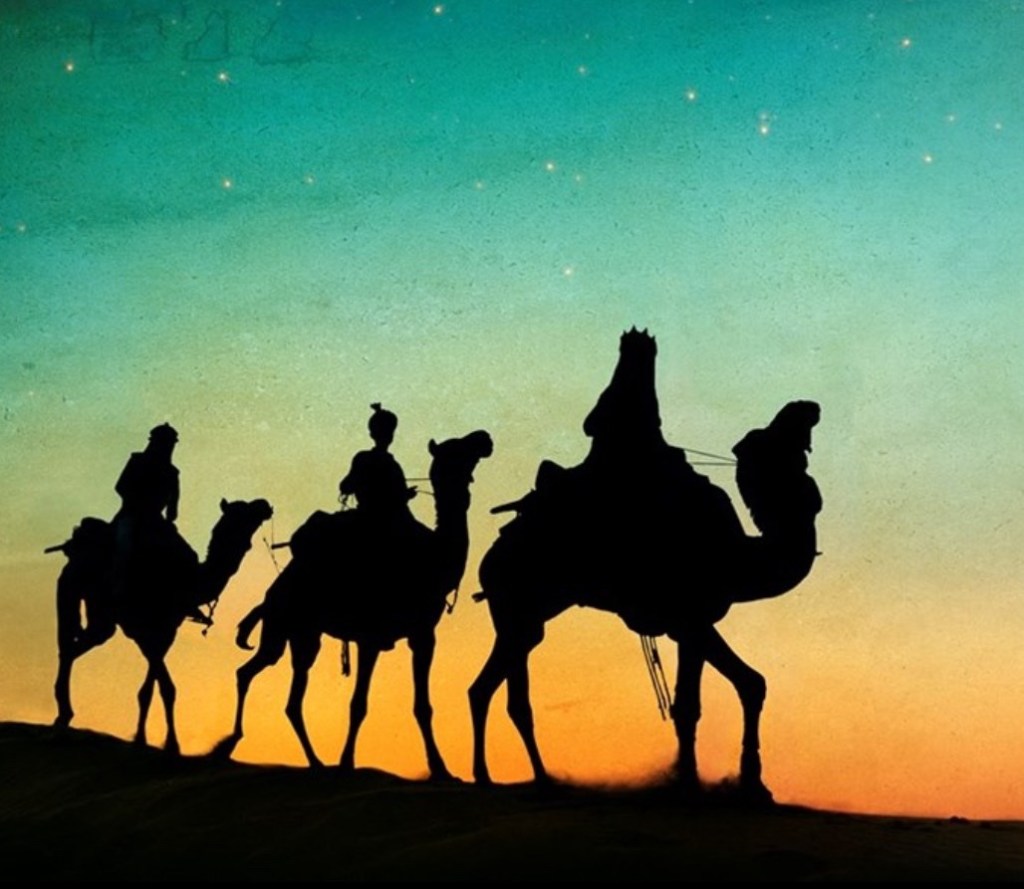
My 2025 Christmas reflection is “Journey of the Magi” by Thomas Stearns Eliot (1888 – 1965), better known as “T.S. Eliot.”
Eliot was born in St. Louis, Missouri but moved to England in 1914 at the age of 25. He became a British citizen in 1927. That same year he converted to the Anglo-Catholic Church, and wrote “Journey of the Magi.” Eliot described his religious beliefs as “a Catholic cast of mind, a Calvinist heritage, and a Puritanical temperament.”
Eliot’s “Journey of the Magi” retells the symbolic story of the biblical Magi who, according to the Gospel of Matthew, travelled to Bethlehem to visit the newborn Jesus. The poem is a narrative, told from the point of view of one of the Magi. It expresses themes of alienation, regret, and a feeling of powerlessness in a world that has changed. In 1927, T.S. Eliot’s spiritual world had changed significantly as well.
The birth of Jesus was the death of the world of magic, astrology, and paganism (cf Colossians 2:20). Jesus’ life, death, and resurrection brought change, hope, and new life.
The speaker, recalling his journey in old age, suggests that after that birth his world had died, and he had little to do but wait for his own death and movement to new life. The poem is not pessimistic. But the journey’s physical hardships mirror the internal struggle of letting go of old beliefs for a deeper truth, revealing that spiritual awakening can be a traumatic but necessary path to a new meaning. T.S. Eliot’s spiritual awakening was his letting go of Unitarianism and becoming an Anglo-Catholic Christian.
T.S. Eliot is my favorite poet. His lines from the poem “Little Gidding” inspired my blog: “For last year’s words belong to last year’s language. And next year’s words await another voice. And to make an end is to make a beginning.”
JOURNEY OF THE MAGI
A cold coming we had of it,
Just the worst time of the year
For a journey, and such a long journey:
The ways deep and the weather sharp,
The very dead of winter.’
And the camels galled, sorefooted, refractory,
Lying down in the melting snow.
There were times we regretted.
The summer palaces on slopes, the terraces,
And the silken girls bringing sherbet.
Then the camel men cursing and grumbling
and running away, and wanting their liquor and women,
And the night-fires going out, and the lack of shelters,
And the cities hostile and the towns unfriendly.
And the villages dirty and charging high prices.
A hard time we had of it.
At the end we preferred to travel all night,
Sleeping in snatches,
With the voices singing in our ears, saying
That this was all folly.
Then at dawn we came down to a temperate valley,
Wet, below the snow line, smelling of vegetation;
With a running stream and a water-mill beating the darkness,
And three trees on the low sky,
And an old white horse galloped away in the meadow.
Then we came to a tavern with vine-leaves over the lintel,
Six hands at an open door dicing for pieces of silver,
And feet kicking the empty wine-skins.
But there was no information, and so we continued
And arriving at evening, not a moment too soon
Finding the place; it was (you might say) satisfactory.
All this was a long time ago, I remember,
And I would do it again, but set down.
This set down.
This: were we led all that way for
Birth or Death? There was a Birth, certainly
We had evidence and no doubt. I had seen birth and death,
But had thought they were different; this Birth was
Hard and bitter agony for us, like Death, our death.
We returned to our places, these Kingdoms,
But no longer at ease here, in the old dispensation,
With an alien people clutching their gods.
I should be glad of another death.
My warmest regards to all and every good wish for Christmas and the New Year 2026. I will be with family and friends for a couple of weeks but return to Another Voice on January 7th.
I know that over the years I have touched on the Jesus Infancy Narratives. But I return to them again in this second week of Advent 2025, simply because so many people have asked me to do that.
The Infancy Narratives are not strictly historical. They are creative images to convey theological perspectives on the historical Jesus. Our Sacred Scriptures, in fact, have a variety of literary forms by which our Christian beliefs are expressed and communicated. We find poetry, drama, symbolism, metaphors, imaginative recreations of past events, and varying degrees of historical narration.
The Bible – Hebrew Scriptures & New Testament — has a lot of history of course but it is not primarily a history book. The focus is the human Faith Experience and Hebrew and Christian beliefs, often expressed symbolically. I resonate with the observation of the Irish-American biblical scholar John Dominic Crossan (born 1934): “My point, once again, is not that those ancient people told literal stories and we are now smart enough to take them symbolically, but that they told them symbolical and we are now dumb enough to take them literally.”
Most people really ignore the differences found in the Jesus Infancy Narratives in Matthew, chapters 1 and 2, and Luke, chapters 1:5 to 2:52. They simply combine the accounts without noticing the differences. Nor do they know or realize that folkloric legends that began centuries after Jesus’ birth were added to the mix.
In Matthew we do find: the visit of the wise men, the star, and Herod’s plot to kill Jesus. These are not found in Luke however.
In Luke, on the other hand, we find: the birth of John the Baptist, the shepherds, and the presentation of Jesus at the Temple. But these are not found in Matthew.
The differences between Matthew and Luke are nearly impossible to reconcile, although they do share some similarities.
The U.S. American biblical scholar and Catholic priest, John Meier (1942 to 2022), often stressed that Jesus’ birth in Bethlehem is not to be taken as an historical fact. Meier describes it as a “theological affirmation put into the form of an apparently historical narrative.”
For example, the belief that Jesus was a descendant of King David led to the development of a story about his birth in Bethlehem, because King David (c. 1010 to c. 970 BCE) was born and raised in Bethlehem.
The Bethlehem Church of the Nativity, built in the fourth century CE and located in West Bank, Palestine, was built over a cave where supposedly Mary gave birth to Jesus. The church was originally commissioned by Constantine the Great (c. 272 to 337 CE) a short time after his mother Helena’s visit to Jerusalem and Bethlehem in 325 and 326 CE.
Helena (c.248 to 330) had been instructed by her son to find important Christian places and artifacts, since Christianity was becoming the dominant religion of the Roman Empire. She hired “helpful” tour guides.
Helena paid her tour guides very well, and they came up with very creative “discoveries” for her that greatly pleased her son Constantine. Helena’s tour guides found a bunch of old bones called the “relics of the Magi.” They were kept first in Constantinople; but then moved to Milan.
Eight centuries later, in 1164, the Holy Roman Emperor Frederick Barbarossa (1122 to 1190) took the “relics of the Magi” and gave them to the Archbishop of Cologne. Whatever they really are has been debated since 1864 when the contents of the reliquary were examined. Researchers found human bones, some young and some old; remnants of clothing; and coins from the the twelfth century. The relics are still in Cologne Cathedral.
[Helena’s tour guides also found for her: three pieces of wood said to be actual pieces of the “True Cross;” two thorns, said to be from Jesus’ crown of thorns; and a piece of a bronze nail, said to be from the crucifixion itself. And finally, they found a piece of wood said to be from the sign Pontius Pilate was said to have erected over Jesus when he was crucified. Helena and Constantine were delighted.]
Some differences in Infancy Narratives: Unlike the infancy narrative in Luke, Matthew mentions nothing about a census, nothing about a journey to Bethlehem, and nothing about Jesus’ birth in a stable. In Matthew, after Jesus’ birth in Bethlehem, the Wise Men from the east visit Baby Jesus at Joseph and Mary’s house in Bethlehem. They were led there by a star, to fulfill the Hebrew Scriptures prophecy of Micah 5:2, that a ruler for Israel would come from Bethlehem.
Most contemporary scholars do not consider Matthew’s story about a star leading the Wise Men to Jesus to have been an historical event. The ancients believed that astronomical phenomena were connected to terrestrial events. Linking a birth to the first appearance of a star was consistent with a popular belief that each person’s life was linked to a particular star.
According to Luke, a census was called for throughout the Roman Empire. It meant that Joseph and a very pregnant young Mary – probably between 12 or 14 years old — had to go to Bethlehem, since Joseph was of the “house of David.” It could have taken nearly a week to do this journey. When they got there, there was “no room for them in the inn,” and so Jesus was born and put in a stable’s manger. [Some people really do not know that a manger is a feeding trough for animals. The English word comes from the Old French word mangier — meaning “to eat” — from the Latin mandere, meaning “to chew.”]
Difficulties in Luke: There are major difficulties in accepting Luke’s Roman census account. First it could not have happened in the days of King Herod. Luke refers to a worldwide census under Caesar Augustus when Quirinius was governor of Syria. But Publius Sulpicius Quirinius was not appointed as the governor of Syria until 6 CE, when Herod had already been dead for ten years.
In addition, according to the records of ancient Roman history, no such census under Caesar Augustus ever took place. In fact, there was no single census of the entire Roman Empire under Augustus. More importantly, no Roman census ever required people to travel from their own homes to those of distant ancestors. A census of Judaea, therefore, would not have affected Joseph and his family, living in Galilee.
Luke clearly followed the models of historical narrative which were current in his day. He needed an explanation for bringing Joseph and Mary to Bethlehem, in order to have Jesus born there. Let’s call the journey to Bethlehem an example of Luke’s “creative historical imagination.”
In Luke, we have no Wise Men, as we saw in Matthew, but angels appear to lowly shepherds, telling them to visit Baby Jesus. The angels then sing out the famous words: “Glory to God in the highest, and on earth peace, and good will to all people.”
According to Luke, Jesus was circumcised eight days after his birth. Then forty days after his birth, Mary and Joseph took the infant Jesus to the Temple in Jerusalem to complete Mary’s ritual purification after childbirth. Mary and Joseph simply followed the regulations in Leviticus 12:1-8. The holy family then returned to their home in Nazareth. Notice that Luke makes no mention of a trip to Egypt, which was mentioned by Matthew in chapter 2.
Luke’s Infancy Narrative concludes with the story about a very bright twelve-year-old Jesus. While on a trip to Jerusalem, Mary and Joseph temporarily could not find Jesus. But to their later amazement, they later found him speaking in the temple and astounding the temple teachers with his understanding.
To summarize:
Matthew’s infancy narrative, written between 80 and 90 CE, and after the Jerusalem Temple’s destruction in 70 CE, focuses on establishing that Jesus was the promised Hebrew Messiah, the fulfilling Hebrew Scripture prophecy for his Hebrew-Christian audience. Matthew’s genealogy (Matthew 1:1-17) traces Jesus’ lineage therefore from Abraham to Joseph, structured in three sets of 14 generations to emphasize Jesus as the promised Messiah.
Luke’s infancy narrative, also written between 80 and 90 CE, focuses on Jesus as the universal Savior for all people, emphasizing his humble birth and God’s care for the marginalized, setting the stage for Jesus’ mission of global witness and salvation, not just for those linked with the Hebrew tradition. Luke’s genealogy (Luke 3:23-38) traces Jesus’s lineage backward from Joseph, through David, Abraham, and all the way to Adam and God, emphasizing that Jesus is for all humanity.
We, two thousand years later, are astounded by Jesus, his life, and his message.
The Infancy Narratives in Matthew and Luke give us some of the most cherished New Testament images, which have influenced and inspired the imagination of all who read them. As we hear these familiar stories once again this Christmas, we would do well to remember that these Infancy Narratives are not just about Baby Jesus.
The Infancy Narratives are about Jesus’ vision and spirit. They animate us and give us hope for today and tomorrow.
In this first week of Advent 2025, I would like to share some thoughts for new as well as regular Another Voice readers, about history and figuring out the date for Jesus’ birthday.
One thing that older historians learn is that life is neither linear nor circular. Life is spiral. As we grow, we notice some things coming around again. But we see them from a better perspective and often with a deeper understanding. This certainly applies to the history of Jesus of Nazareth.
The “birthday” of Jesus of Nazareth is not mentioned anywhere in the New Testament, which is quite silent about the day or the time of year when Mary gave birth to her son. Historians know that in keeping with Hebrew customs at the time, Mary was between 12 and 14 years old when her son Jesus was born. Her husband was probably a couple years older. In Aramaic, the language spoken by Jesus and his parents, Mary was called Myriam.
We know very little about Mary’s husband Joseph. He is not mentioned in the Gospels after the incident, mentioned in Luke 2:41-52, where the 12-year-old Jesus was left behind in Jerusalem. Nor is he mentioned at the crucifixion when Jesus entrusted his mother to the care of the “beloved disciple.”
[Interesting of course is that the Gospel of Mark mentions Jesus’ brothers, named: James, Joses (Joseph), Judas, and Simon. The passage also mentions that Jesus had sisters, though they are not named. The reference appears in Mark 6:3. But this leads to a discussion for another time.]
Today we know that the actual date for the birth of Jesus (Yeshua in Hebrew) is unknown. It is not found in the Gospels nor in any bonafide historical sources. Most contemporary biblical scholars and historians suggest, however, that Jesus’ birth was between 6 and 4 BCE. [The designations with “CE” (for Common Era) originated in 1708 but were not widely used until the late 20th century, particularly in scientific and academic fields. Jewish scholars have used “CE” frequently for over a century. Its broader adoption today is due to its cultural neutrality compared to the religiously specific BC/AD designations.]
Early Christians did not focus on Jesus’ birth. The key Jesus-event for them was Easter. They rejoiced in their belief that Jesus was raised from the dead and entered a new form of life: promising new life for all who believed and followed him. Christians were and are Easter people.
In the second century, some Christians did begin to celebrate Jesus’ birth. But there was no agreement about a specific birth date. The infancy narratives in the Gospels of Matthew and Luke do not mention a date or time of year for the birth of Jesus. The eminent Catholic theologian Karl Rahner, S.J. (1904-1984) stressed that the authors of the Gospels focused on theological beliefs rather than historical chronologies.
In the third century, however, the precise date for celebrating Jesus’s birth became a subject of great interest, with early Christian writers suggesting various dates. Later in the early fourth century, some Christian writers acknowledged that Jesus’ birth coincided with the winter solstice. They saw the lengthening days after the winter solstice as symbolizing the Light of Christ entering the world.
Around 350 CE, Pope Julius I (280-352) officially set December 25th as the date for celebrating Jesus’ birth. By the end of the 4th century, December 25th was widely recognized as the date for celebrating Jesus’ birth (centuries later called Christmas) in the Western Roman Empire. January 6 was the date in the East.
The word Christmas arrived in Old English in 1038 as Cristemasse, a shortened form of “Christ’s Mass,” which referred to a celebration of the Eucharist (Mass) to commemorate the birth of Jesus.
Most historians do not believe that the December 25 Jesus’ birth date was created by copying the Roman Sol Invictus (Invincible Sun) festival, though but the claim still remains popular with some people. The claim, however, is not supported by historical evidence, which indicates that the Sol Invictus festival was not originally celebrated on December 25th.
Historians stress that the Roman Emperor Aurelianus (214-275) changed the festival of the Sol Invictus date to December 25th in 274 CE, to counteract Christianity’s growing influence. Prior to this, the Sol Invictus had been celebrated earlier in December. Christian leaders like Hippolytus of Rome (170-235), who was Bishop of Rome and one of the most important Christian theologians of the second and third centuries, had identified and stressed December 25th as Jesus’ birth date long before the earliest records of Sol Invictus being celebrated on that day.
Actually, the idea of linking the birth of Jesus with the Sol Invictus festival was first suggested in the 12th century and later popularized by post-Enlightenment scholars.
When it comes to the New Testament Jesus Infancy Narratives, I suspect that most people simply ignore the differences found in the Gospels of Matthew and Luke. They easily combine the accounts without noticing the differences. Nor do they realize that imaginative infancy suppositions, that arose centuries after Jesus’ birth, got thrown into the mix.
In reality, most of our contemporary Jesus-birth imagery comes from the Catholic friar, Giovanni di Pietro di Bernardone (1181-1226), known today as St. Francis of Assisi.
As Christmas approached in 1223, St. Francis asked his friend Giovanni Velita to help him create a live Nativity scene. They set up a cave with animals, a hay-filled manger, and real people portraying Mary and Joseph. Francis had a statue of a baby for infant Jesus; and he himself would proclaim the Gospel, inviting all to enter into the story of Jesus Christ’s birth.
On Christmas eve 1223, people gathered with candles and torches to see and experience the live Nativity scene. It was in fact much more than just a display. It was a spiritual encounter with the miracle of the Incarnation. An eyewitness account reports that during the Mass, a real infant somehow appeared in the manger, and St. Francis, filled with joy, embraced the child.
St. Francis’s Nativity scene spread quickly, becoming a long-standing tradition. It was not just an historic display, but an invitation to experience the meaning of Jesus’ birth firsthand: seeing his humility, poverty, and love.
As we celebrate Christmas in three weeks, we are invited to do the same. St. Francis’s Nativity scene calls us to reflect on the simplicity of Jesus’ birth and the love that came with it: the love that we share because God is love.
Next week, in keeping with the season, some thoughts about the Jesus Infancy Narratives in Matthew and Luke.
Jack
****
I am thankful for the Another Voice donations that have come in so far. In case someone would still like to donate, I include donation info – one last time — with three primary ways readers can contribute:
By U.S. dollar check made out to “John Dick” and sent to my niece in Michigan who will deposit it to my U.S. bank. Send to: Dr. J. A. Dick c/o Mrs. Sarah Dickinson, 15298 Remington Lane, Holland MI 49424.


 Another Voice