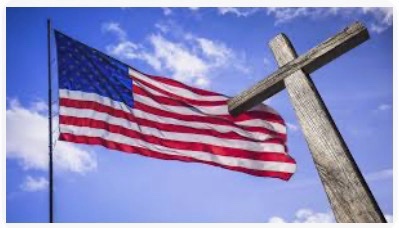
Over the 2025 Christmas holidays, contemporary American political leadership, with its staunch support for Christian Nationalist Authoritarianism seems to have been working hard to transform American society and even re-write American history.
Christian Nationalist Authoritarianism promotes a specific kind of conservative Christian civic life and argues that only “Christians” can be “true Americans.” It merges right-wing religious ideology with anti-democratic, pro-authoritarian political views, as it pursues the Seven Mountain Mandate: a belief, promoted by the New Apostolic Reformation movement (NAR), that the current political administration has a divine commission to take over and control the “seven spheres” of society: family, religion, education, media, entertainment, business, and government.
I remember the words of Charlie Kirk (1993-2025), speaking on February 27, 2020, at the Conservative Political Action Conference in Fort Washington, Maryland: “Finally we have a president that understands the seven mountains of cultural influence.” Very interestingly a January 2024 poll by Denison University, a a private liberal arts college in Granville, Ohio in Granville, Ohio found that 41% of American Christians believe in the Seven Mountain Mandate.
Promoters of Christian Nationalist Authoritarianism are actually quite ignorant about American history. The incumbent American Vice President is a good example. Speaking at the Turning Point USA [Turning Point was founded by Charlie Kirk] “AmericaFest” conference on December 21, 2025, the Vice President said, to great applause: “The only thing that has truly served as an anchor of the United States of America is that we have been, and by the grace of God we always will be, a Christian nation.” But that is really not true.
The Declaration of Independence (July 4, 1776) appealed to “the laws of Nature and Nature’s God” and asserted that all people have basic rights “endowed by their Creator.” The Founders, however, did not want the nation to be controlled by theocrats. They understood the importance of separating “church” and “state” as important for the protection of “church” and for the protection of the “state.”
The First Amendment to the United States Constitution, adopted on December 15, 1791, prevents Congress from making laws respecting an establishment of religion; prohibiting the free exercise of religion; or abridging the freedom of speech, the freedom of the press, the freedom of assembly, or the right to petition the government for redress of grievances. It is one of the ten amendments that make up the Bill of Rights.
Already in 1790, the year after he took office as the nation’s First President, George Washington assured a Jewish congregation in Newport, Rhode Island, that in the United States of America, “all possess alike liberty of conscience and immunities of citizenship.” The Government of the United States, he wrote, “gives to bigotry no sanction” and “to persecution no assistance.” He hoped that Jewish Americans woukd “continue to merit and enjoy the good will of the other inhabitants, while everyone shall sit in safety under his own vine and fig tree and there shall be none to make him afraid.”
The contemporary United States is a country that is 71% Christian. But more than 20% of older Americans today have no religious preference. Some are atheists or agnostics. Others simply identify as “nothing in particular.” Over 45% of today’s young adult Americans, aged 20 to 34, however, identify as “non-religious,” a significant shift from about thirty years ago.
Contemporary Christian Nationalist Authoritarianism is a dangerous socio-political virus. It not only threatens democracy and denigrates specific groups of people but advocates behavior contrary to the life and teachings of Jesus Christ.
Yes. There will be a lot to think about and react to in 2026, the year that we will celebrate the 250th anniversary of the Declaration of Independence, when British colonists on the North American continent launched the experiment of a government based on the rule of law created by the people themselves. I have no doubts that 2026 will be an incredibly significant year.
A good 2026 new year’s resolution for all of us is making a renewed commitment to see and reflect as we work together with compassion, understanding, and mutual respect.
- Jack
.
 Another Voice
Jack, your concluding paragraph: “A good 2026 new year’s resolution for all of us is making a renewed commitment to see and reflect as we work together with compassion, understanding, and mutual respect.”
… gives me new heart after a very disappointing start to the new year. I jump on the resolution and wholeheartedly endorse it. Hopefully it will guide me this year and beyond. Thank you for reminding me of what I can and should be doing. God bless.
Many thanks my friend!
Dear Jack,
Welcome back from what, I hope, was a peaceful and relaxing respite with your family. It is reassuring to read your words once again as we start the new year. It will be, hopefully, a year of positive change and reaffirmation of the true Christian/American values you so beautifully delineated. It is truly incumbent upon us who value all freedoms to stand up against this insidious distortion of our values both of faith and government. May 2026 truly be a renewal of what we have thought were our founding fathers’ intent: liberty and justice for all. Peace, dear friend!
Frank
Frank
I am happy to be back after some delightful days with family and friends. And right now we’re having a big snow storm…unusual for Leuven.
Very warmest regards!
Jack
Excellent! Readers may also be interested in this from Pope Leo” https://www.vaticannews.va/en/pope/news/2026-01/pope-at-audience-7-january-2026.html?utm_source=newsletter&utm_medium=email&utm_campaign=NewsletterVN-EN Gene
Many thanks Gene!