As an historical theologian, I continue to study the evolution of Christian beliefs, doctrines, and interpretations of Scripture across different eras. This week, several readers have asked me for a contemporary clarification of Roman Catholic perspectives on LGBTQ people.
The Catechism of the Catholic Church is a reference work that summarizes the Catholic Church’s doctrine. It was promulgated by Pope John Paul II (1920-2095) in 1992. The Catechism names “homosexual acts” as “intrinsically immoral and contrary to the natural law,” and names “homosexual tendencies” as “objectively disordered.”
In his last personal work, Memory and Identity, published in 2005, Pope John Paul II referred to the “pressures” on the European Parliament to permit “homosexual marriage.’’ He wrote: “It is legitimate and necessary to ask oneself if this is not perhaps part of a new ideology of evil, perhaps more insidious and hidden, which attempts to pit human rights against the family and against man.”
Pope Benedict XVI (1927-2022) basically agreed with John Paul II, holding the traditional Catholic position that while individuals with homosexual inclinations should be treated with respect and compassion, homosexual acts and same-sex marriage were considered “intrinsically disordered”
Pope Francis (1936 – April 21, 2025) adopted a significantly more accommodating tone on LGBTQ topics than his predecessors. In July 2013, his televised “Who am I to judge?” statement was widely reported in the international press, becoming one of his most famous statements on LGBTQ people. Nevertheless, on topics directly effecting LGBTQ people, his words and actions, during his 12-year leadership, were mixed at best.
On September 25, 2023, in a responsum to conservative cardinals before the 16th World Synod of Bishops, Francis expressed an openness to blessings for same-sex couples as long as they did not misrepresent the Catholic position that marriage is not possible for same-sex people and can only be between one man and one woman.
On May 27, 2024, during a closed-door meeting of the Episcopal Conference of Italy, Pope Francis, using words that denigrated gay men, strongly opposed the admittance of gay men as seminarians.
On July 30, 2025, in a wide-ranging interview with Crux Senior Correspondent Elise Ann Allen, Pope Leo XIV (born 1955 and elected pope on May 8, 2025) said that his approach to LGBTQ Catholics would be similar to that of his predecessor, saying the Church must accept “everyone, everyone, everyone.” Yet, he rejected doctrinal changes such as recognizing same-sex marriage, asserting that “the teaching of the Church will remain unchanged.”
Nevertheless, starting especially in 2023, elements of change have begun to appear in the Catholic Church.
On March 10th 2023, for example, the German Catholic bishops approved same-sex blessings, as part of a vote by the Synodal Path. The resolution called for blessing ceremonies for same-sex couples to be officially allowed in German Catholic dioceses.
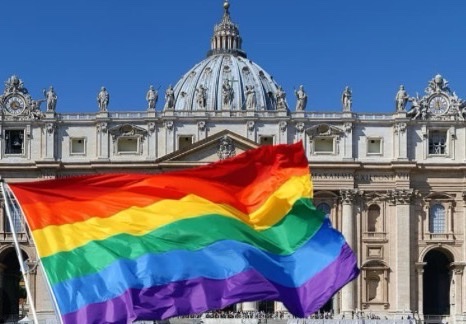
An especially significant moment came on September 6, 2025, when LGBTQ Catholics in rainbow attire took part in the first officially recognized LGBTQ pilgrimage to Rome during the Roman Catholic Jubilee Year. The pilgrimage included a procession through the Holy Door of St. Peter’s Basilica. The event saw over a thousand participants from around the world. A Mass was celebrated for the pilgrims in Rome’s Church of the Gesù, presided over by Bishop Francesco Savino, Bishop of the Diocese of Cassano and Vice President of the Italian Bishops’ Conference for Southern Italy.
In his homily, Bishop Savino spoke about restoring dignity to those who have been denied it. “Before sharing what the Word of God generated in me and what the Spirit generated in me, I would like to obediently listen to its action and invite you all to look at each other. Look at each other! Look at each other! We are a group of faces facing. We are a group of real stories. We are a group of people who ask with dignity, authenticity, and truth to be recognized. Each one with their own story. Each one with their own wounds. But each with their own beauty, with the beauty that lives within each of us, regardless of our fragilities. And we want to leave this celebration more joyful and more hopeful than ever. We want to leave convinced that God loves us, of a singular and unique love, of an asymmetrical love, of a love without conditions.”
Yes. There has been positive development in the Roman Catholic understanding of human sexuality. I was thinking recently about my theologian friend Todd A. Salzman and his colleague Michael G. Lawler, at Creighton University, in Omaha, Nebraska. In 2008, they published their ground-breaking book The Sexual Person (Georgetown University Press). They stressed that two principles had captured the essence of the official Catholic position on the morality of sexuality: first, that any human genital act must occur within the framework of heterosexual marriage; second, each and every marriage act must remain open to the transmission of life.
Remaining firmly within the Catholic tradition, they contended that the Catholic Church has been inconsistent in its teaching by adopting a dynamic, historically conscious anthropology and worldview on social ethics and the interpretation of scripture while adopting a static, classicist anthropology and worldview on sexual ethics. While some documents from the 1962-1965 Vatican II, like Gaudium et spes (“the marital act promotes self-giving by which spouses enrich each other”), gave hope for a renewed understanding of sexuality, the church had not carried out the full implications of this approach.
In short, Salzman and Lawler emphasized relationships, not acts, and recognized Christianity’s historically and culturally conditioned understanding of human sexuality.The Sexual Person draws historically, methodologically, and anthropologically from the best of Catholic tradition.It provides a context for theological conversations between “traditionalists” and “revisionists” regarding marriage, cohabitation, homosexuality, reproductive technologies, and what it means to be human.
In a 2024 article in Theological Studies, Todd Salzman and Michael Lawler stressed: “There is ambivalence in definitions of Catholic sexual human dignity and Catholic social human dignity, which lead to inconsistencies in the foundation and justification of moral doctrine.” They warn about “harm that results from inconsistent definitions of human dignity in doctrinal teaching.”
Their most recent book, which I strongly recommend is Sexual and Gender Doctrinal Language: A Source of Pain and Trauma in the Catholic Church (Paulist Press, 2025). Here they underline that official doctrinal language on sexual and gender issues causes pain and trauma for many contemporary Catholics. Relying on the sources of ethical knowledge (tradition, scripture, reason, and experience), Todd and Michael propose revisions to Catholic anthropology, ecclesiology, and ethical methodology supporting those doctrines. This would continue to move the Catholic Church forward and to realize the synodal ecclesiology and “new pastoral methods” of Pope Francis (1936-2025), as exemplified in his April 8, 2016, apostolic exhortation, Amoris Laetitia.
In his foreword to the book, James F. Keenan, SJ, moral theologian, bioethicist, and professor at Boston College, writes: “We ethicists believe that we must find the truth, and in part that means naming not only what is lacking, but what was not virtuously expressed. In this work, Lawler and Salzman offer their insights into the ongoing discourse to find virtuous pathways for contemporary Christians on the way of the Lord.”
Roman Catholic institutional change often comes slowly. But it does happen.
Jack
___________________
Dr. John A. Dick
“History gives answers to those who know how to ask questions.”
 Another Voice
Jack
Thanks for the treatise; it’s a great historical account.
I am going to respond to you via email rather than posting on FB as by business relationship with the church demands caution.
I am one of those who might be defined as “caught up in the confusing positions/statements”, but I happen to have been gifted with a different/lived perspective.
First, a foundational moral principle, Lex dubiat non obligat. Those Catholics who are troubled by the official position/teaching should always be counseled toward this statement.
Second, there is a major hierarchical integrity disconnect. Priests, bishops, and cardinals in significant numbers engage in homosexual acts; some do this as expressions of love, others have never been taught how genital sexual expression is a means of the authentic expression of love. I count myself in the latter group as this concept was never faced, taught, or modeled in my family of origin.
While there is forward movement on the part of the church, fear/shame among the hierarchy prevents any significant progress. The problem is more scientific, i.e. there are same sex oriented individuals throughout the animal kingdom. There seems to be some presumption that a deity that created could not make any errors in said creation. I think that concept falls apart given the scientific evidence to the contrary.
The hard reality for those of us who are same sex oriented is the pace, the amount of time it will take the leadership of the Catholic church to come to grips with human reality. Our lives, our mental health, our sexuality does not allow us the time to wait for that to happen. In advance of that, there will have to first be a major shift on the attitudes toward women, an acceptance of demonstrated scientific realities, and the courage to step forward and own the reality of human sexual expression.
I think that the Catholic church’s teaching on masturbation, which I heard at a parish-sponsored mission when I was about 13, has done so much to screw us up, both men and women, that clarity will most likely have to begin back at this basic phenomenon, teaching that any damage associated with masturbation is that which causes the practitioner to be so emotionally withdrawn into self, would be the necessary shift. And that can be reasonably built upon to a much more reasonable/authentic sexual morality.
At any rate, I look forward to your reaction.
Peace and blessings!
Joe
From: Another Voice comment-reply@wordpress.com Sent: Wednesday, January 21, 2026 2:09 AM To: joe@sankovich.com Subject: Theological Perspectives on Human Sexuality
As an historical theologian, I continue to study the evolution of Christian beliefs, doctrines, and interpretations of Scripture across different eras. This week, several readers have asked me for a…
https://foranothervoice.files.wordpress.com/2026/01/image.jpg?w=40
Another Voice
Read on blog or Reader
Theological Perspectives on Human Sexuality
https://0.gravatar.com/avatar/f16b9b00a20fbff6143b51b823b1837f68ffddc73f2527ea4b7a46e8e8a45072?s=24&d=identicon&r=G
By Dr. John A. Dick on January 21, 2026
https://foranothervoice.wordpress.com/wp-content/uploads/2026/01/c0587700-1065-4470-befe-6ba0254b7f67-1045-000000fd9703b147_file.jpg?w=466
As an historical theologian, I continue to study the evolution of Christian beliefs, doctrines, and interpretations of Scripture across different eras. This week, several readers have asked me for a contemporary clarification of Roman Catholic perspectives on LGBTQ people.
The Catechism of the Catholic Church is a reference work that summarizes the Catholic Church’s doctrine. It was promulgated by Pope John Paul II (1920-2095) in 1992. The Catechism names “homosexual acts” as “intrinsically immoral and contrary to the natural law,” and names “homosexual tendencies” as “objectively disordered.”
My very warmest regards!
/Dear Dr Dick;
I think I may have spotted a typo:
The Catechism of the Catholic Church is a reference work that summarizes the Catholic Church’s doctrine. It was promulgated by Pope John Paul II (1920-2095) 2005??
Anyway, I am writing you because I am attempting to understand the origin of the concept of Sacrament in the Church. I am pretty sure that Tertullian may have been the first to use the term in reference to Baptism, but as I understand, he did not develop the concept of Sacrament. Can you point me in the right direction?
Many thanks Edward. A typo for sure. Pope John Paul II died in 2005.
The English word sacrament is derived indirectly from the Ecclesiastical Latin sacrāmentum. In Ancient Rome, the term meant a soldier’s oath of allegiance. Tertullian, a 3rd-century Christian writer, suggested that just as the soldier’s oath was a sign of the beginning of a new life, so too was initiation into the Christian community through baptism and Eucharist.
My good friend Joseph Martos, passed away in 2020, wrote what is still the best introduction to the sacraments: “Doors to the Sacred: A Historical Introduction to Sacraments in the Catholic Church.”
Many kind regards
Jack
Wow. Brave and well done. I appreciate the book and author references. I also appreciated the comments by JBSANKOVICH. Thank you for that. But . .
The books you reference are a decent attempt to move this discussion forward – but they are way too complicated. Most other Christian Churches have adopted a much healthier position. I think Gabriel Moran put this the most succinctly – you really have to let go of the idea that the Church, be it council or pope, has ever taught anything that is INFALLIBLE. I say this as a person who got an STD in Moral Theology from the Lateran University many years ago. Religous leaders should provide some insight into moral decisions – but we should not be operating with philosophy and physiology that is totally outdated.
Our understanding of humankind is always improving. Homosexuality, same sex love and caring, is a simple biological fact in many of our fellow human beings. Like most other human traits, sexuality is not binary in any way – it is a broad spectrum. Some “enlightened” theologians recognize this, but then tell people that they must be celibate to avoid sin. That leads us to the next point.
Our church has fixated on sexuality beyond belief. Sex is a simple fact of being alive, much the same as eating, and we should celebrate it, enjoy it, etc. The idea that every sexual act must be open to creating life is just a narrow minded view of some old celibate men. Let it go. That is to say nothing of the thousands of priests who abused youth and others for decades. And in many parts of the world, most of the clergy think the idea of clerical celibacy is also ridiculous, and they ignore it, with impunity.
The problem as I see it is that at some point MOST of us will understand this simple fact. I fearlessly predict that we will let go of this church and join some other one. Our local youth minister pointed this out to us 20 years ago. This is probably the key issue for “moderns” – along with the subservient role of women. More on that later!
Thanks, as always.
My sincere thanks Carl!
Jack
Many thanks for this encouraging article. Shalom/pax Gene
Thanks Gene!
Jack
I wonder if part of the confusion is how “marriage” is understood by Catholics in the religious sense, while most of the rest of the world uses it in a secular or legal sense. Perhaps if the Magisterium reserved the Catholic religious sense of the concept to the term “Matrimony”, it would clarify the confusion.
Personally, I think that most lay Catholics use the term marriage in a secular or legal sense, in their own lives & really don’t worry about what the professional & advanced Catholic thinkers are arguing over!!
A very good observation!
Thanks Kay
Jack
I have known a homosexual couple who were faithful to each other for over fifty years until the death of one of them last year. He had been my roommate in the seminary and left the priesthood after a few years and entered the same sex union. He was a sterling and moral individual with high standards and his life with his partner was a good example to all.
You quoted that mantra of the Church: “each and every marriage act must remain open to the transmission of life.” That is the euphemism which moral theology used to replace: “depositing of seed in the vagina” which is the way I was taught in the seminary in the 1950s. Today it sounds crude and biological but in the 50s it was truth and direct. It is also a sign of how the Church has always had severe difficulty dealing with human sexuality.
When I hear someone express revulsion over homosexuality, I always ask if they remember the day and time they intellectually decided to be heterosexual rather than homosexual. Neither decision ever existed. Our cravings and capacity for human relationships are not our decisions; they are our personal set of natural capacities and possibilities. A loving and creative God established it that way.
Many thanks Bill.
Now we move ahead.
Jack
In general, the doctrine of our Church holds that human beings are not able to fully comprehend God’s intentions. An apparent exception, however, seems to be the area of sexuality, where those intentions are presented as being clearly defined (for example, in Casti Connubii). To me, classifying an excessively wide range of behavior in this area as grave sin risks diminishing the perceived seriousness of sins in other areas of life. A step in a more balanced direction may be found in paragraph 2352 of the Catechism of the Catholic Church, where the gravity of masturbation is, at least to some extent, placed in a more nuanced context.
Many sincere thanks!
Perhaps masturbation was a particular problem for celibate monks and priests?😉
As one of the multitude of children abused by priests, the idea of supposedly single, supposedly celibate, supposedly childless men pontificating on sex and sexuality is obcene
Indeed. We need a new reformation.
Jack,
Thank you for laying this out historically and without caricature. As someone who studies theology and also lives at the intersection of faith and queer identity, I find the anthropology question you raise to be the real heart of the matter.
The Catechism’s language — “intrinsically disordered,” “objectively disordered” — is not abstract for many of us. It is deeply personal. Whatever its technical meaning within Thomistic moral theology, it has functioned pastorally as a wound for many LGBTQ Catholics.
At the same time, I don’t think the central question is whether the Church will become more welcoming in tone. That shift has clearly begun. The deeper issue is whether Catholic sexual anthropology itself is static or capable of organic development in the same way Catholic social teaching has evolved.
Salzman and Lawler’s critique about dynamic anthropology in social ethics versus static anthropology in sexual ethics is worth serious engagement. It raises a legitimate methodological question: why does historical consciousness apply in one moral domain but not the other?
And yet, I also hesitate when development is framed as inevitable progress. Catholic theology is not simply reactive to culture. If change comes, it must emerge from a coherent rearticulation of dignity, sacramentality, and embodiment — not merely from pastoral pressure.
Personally, I believe human dignity must be the non-negotiable starting point. If doctrinal language causes sustained psychological and spiritual trauma, that demands examination. But examination does not automatically equal reversal. It demands theological depth.
The Jubilee pilgrimage moment you mention felt significant not because doctrine changed, but because visibility and dignity were publicly acknowledged. That matters. Tone is not everything — but tone shapes whether people can even remain in conversation long enough for theology to develop.
As someone committed both to the Church and to intellectual integrity, I am less interested in slogans (either “unchanged forever” or “inevitable reform”) and more interested in whether our anthropology truly reflects the Incarnation — a theology where bodies, desire, relationship, and grace are not enemies.
Institutional change may come slowly. The more urgent question, for me, is whether we can create theological space where faithful LGBTQ Catholics are not reduced to problems to be solved, but participants in discernment.
History gives answers, yes.
But it also reveals how often development begins with listening to those who were once dismissed.
Thank you for continuing that conversation.
Many thanks Josh.
Jack