My 2025 Christmas reflection is “Journey of the Magi” by Thomas Stearns Eliot (1888 – 1965), better known as “T.S. Eliot.”
Eliot was born in St. Louis, Missouri but moved to England in 1914 at the age of 25. He became a British citizen in 1927. That same year he converted to the Anglo-Catholic Church, and wrote “Journey of the Magi.” Eliot described his religious beliefs as “a Catholic cast of mind, a Calvinist heritage, and a Puritanical temperament.”
Eliot’s “Journey of the Magi” retells the symbolic story of the biblical Magi who, according to the Gospel of Matthew, travelled to Bethlehem to visit the newborn Jesus. The poem is a narrative, told from the point of view of one of the Magi. It expresses themes of alienation, regret, and a feeling of powerlessness in a world that has changed. In 1927, T.S. Eliot’s spiritual world had changed significantly as well.
The birth of Jesus was the death of the world of magic, astrology, and paganism (cf Colossians 2:20). Jesus’ life, death, and resurrection brought change, hope, and new life.
The speaker, recalling his journey in old age, suggests that after that birth his world had died, and he had little to do but wait for his own death and movement to new life. The poem is not pessimistic. But the journey’s physical hardships mirror the internal struggle of letting go of old beliefs for a deeper truth, revealing that spiritual awakening can be a traumatic but necessary path to a new meaning. T.S. Eliot’s spiritual awakening was his letting go of Unitarianism and becoming an Anglo-Catholic Christian.
T.S. Eliot is my favorite poet. His lines from the poem “Little Gidding” inspired my blog: “For last year’s words belong to last year’s language. And next year’s words await another voice. And to make an end is to make a beginning.”
JOURNEY OF THE MAGI
A cold coming we had of it,
Just the worst time of the year
For a journey, and such a long journey:
The ways deep and the weather sharp,
The very dead of winter.’
And the camels galled, sorefooted, refractory,
Lying down in the melting snow.
There were times we regretted.
The summer palaces on slopes, the terraces,
And the silken girls bringing sherbet.
Then the camel men cursing and grumbling
and running away, and wanting their liquor and women,
And the night-fires going out, and the lack of shelters,
And the cities hostile and the towns unfriendly.
And the villages dirty and charging high prices.
A hard time we had of it.
At the end we preferred to travel all night,
Sleeping in snatches,
With the voices singing in our ears, saying
That this was all folly.
Then at dawn we came down to a temperate valley,
Wet, below the snow line, smelling of vegetation;
With a running stream and a water-mill beating the darkness,
And three trees on the low sky,
And an old white horse galloped away in the meadow.
Then we came to a tavern with vine-leaves over the lintel,
Six hands at an open door dicing for pieces of silver,
And feet kicking the empty wine-skins.
But there was no information, and so we continued
And arriving at evening, not a moment too soon
Finding the place; it was (you might say) satisfactory.
All this was a long time ago, I remember,
And I would do it again, but set down.
This set down.
This: were we led all that way for
Birth or Death? There was a Birth, certainly
We had evidence and no doubt. I had seen birth and death,
But had thought they were different; this Birth was
Hard and bitter agony for us, like Death, our death.
We returned to our places, these Kingdoms,
But no longer at ease here, in the old dispensation,
With an alien people clutching their gods.
I should be glad of another death.
My warmest regards to all and every good wish for Christmas and the New Year 2026. I will be with family and friends for a couple of weeks but return to Another Voice on January 7th.
I know that over the years I have touched on the Jesus Infancy Narratives. But I return to them again in this second week of Advent 2025, simply because so many people have asked me to do that.
The Infancy Narratives are not strictly historical. They are creative images to convey theological perspectives on the historical Jesus. Our Sacred Scriptures, in fact, have a variety of literary forms by which our Christian beliefs are expressed and communicated. We find poetry, drama, symbolism, metaphors, imaginative recreations of past events, and varying degrees of historical narration.
The Bible – Hebrew Scriptures & New Testament — has a lot of history of course but it is not primarily a history book. The focus is the human Faith Experience and Hebrew and Christian beliefs, often expressed symbolically. I resonate with the observation of the Irish-American biblical scholar John Dominic Crossan (born 1934): “My point, once again, is not that those ancient people told literal stories and we are now smart enough to take them symbolically, but that they told them symbolical and we are now dumb enough to take them literally.”
Most people really ignore the differences found in the Jesus Infancy Narratives in Matthew, chapters 1 and 2, and Luke, chapters 1:5 to 2:52. They simply combine the accounts without noticing the differences. Nor do they know or realize that folkloric legends that began centuries after Jesus’ birth were added to the mix.
In Matthew we do find: the visit of the wise men, the star, and Herod’s plot to kill Jesus. These are not found in Luke however.
In Luke, on the other hand, we find: the birth of John the Baptist, the shepherds, and the presentation of Jesus at the Temple. But these are not found in Matthew.
The differences between Matthew and Luke are nearly impossible to reconcile, although they do share some similarities.
The U.S. American biblical scholar and Catholic priest, John Meier (1942 to 2022), often stressed that Jesus’ birth in Bethlehem is not to be taken as an historical fact. Meier describes it as a “theological affirmation put into the form of an apparently historical narrative.”
For example, the belief that Jesus was a descendant of King David led to the development of a story about his birth in Bethlehem, because King David (c. 1010 to c. 970 BCE) was born and raised in Bethlehem.
The Bethlehem Church of the Nativity, built in the fourth century CE and located in West Bank, Palestine, was built over a cave where supposedly Mary gave birth to Jesus. The church was originally commissioned by Constantine the Great (c. 272 to 337 CE) a short time after his mother Helena’s visit to Jerusalem and Bethlehem in 325 and 326 CE.
Helena (c.248 to 330) had been instructed by her son to find important Christian places and artifacts, since Christianity was becoming the dominant religion of the Roman Empire. She hired “helpful” tour guides.
Helena paid her tour guides very well, and they came up with very creative “discoveries” for her that greatly pleased her son Constantine. Helena’s tour guides found a bunch of old bones called the “relics of the Magi.” They were kept first in Constantinople; but then moved to Milan.
Eight centuries later, in 1164, the Holy Roman Emperor Frederick Barbarossa (1122 to 1190) took the “relics of the Magi” and gave them to the Archbishop of Cologne. Whatever they really are has been debated since 1864 when the contents of the reliquary were examined. Researchers found human bones, some young and some old; remnants of clothing; and coins from the the twelfth century. The relics are still in Cologne Cathedral.
[Helena’s tour guides also found for her: three pieces of wood said to be actual pieces of the “True Cross;” two thorns, said to be from Jesus’ crown of thorns; and a piece of a bronze nail, said to be from the crucifixion itself. And finally, they found a piece of wood said to be from the sign Pontius Pilate was said to have erected over Jesus when he was crucified. Helena and Constantine were delighted.]
Some differences in Infancy Narratives: Unlike the infancy narrative in Luke, Matthew mentions nothing about a census, nothing about a journey to Bethlehem, and nothing about Jesus’ birth in a stable. In Matthew, after Jesus’ birth in Bethlehem, the Wise Men from the east visit Baby Jesus at Joseph and Mary’s house in Bethlehem. They were led there by a star, to fulfill the Hebrew Scriptures prophecy of Micah 5:2, that a ruler for Israel would come from Bethlehem.
Most contemporary scholars do not consider Matthew’s story about a star leading the Wise Men to Jesus to have been an historical event. The ancients believed that astronomical phenomena were connected to terrestrial events. Linking a birth to the first appearance of a star was consistent with a popular belief that each person’s life was linked to a particular star.
According to Luke, a census was called for throughout the Roman Empire. It meant that Joseph and a very pregnant young Mary – probably between 12 or 14 years old — had to go to Bethlehem, since Joseph was of the “house of David.” It could have taken nearly a week to do this journey. When they got there, there was “no room for them in the inn,” and so Jesus was born and put in a stable’s manger. [Some people really do not know that a manger is a feeding trough for animals. The English word comes from the Old French word mangier — meaning “to eat” — from the Latin mandere, meaning “to chew.”]
Difficulties in Luke: There are major difficulties in accepting Luke’s Roman census account. First it could not have happened in the days of King Herod. Luke refers to a worldwide census under Caesar Augustus when Quirinius was governor of Syria. But Publius Sulpicius Quirinius was not appointed as the governor of Syria until 6 CE, when Herod had already been dead for ten years.
In addition, according to the records of ancient Roman history, no such census under Caesar Augustus ever took place. In fact, there was no single census of the entire Roman Empire under Augustus. More importantly, no Roman census ever required people to travel from their own homes to those of distant ancestors. A census of Judaea, therefore, would not have affected Joseph and his family, living in Galilee.
Luke clearly followed the models of historical narrative which were current in his day. He needed an explanation for bringing Joseph and Mary to Bethlehem, in order to have Jesus born there. Let’s call the journey to Bethlehem an example of Luke’s “creative historical imagination.”
In Luke, we have no Wise Men, as we saw in Matthew, but angels appear to lowly shepherds, telling them to visit Baby Jesus. The angels then sing out the famous words: “Glory to God in the highest, and on earth peace, and good will to all people.”
According to Luke, Jesus was circumcised eight days after his birth. Then forty days after his birth, Mary and Joseph took the infant Jesus to the Temple in Jerusalem to complete Mary’s ritual purification after childbirth. Mary and Joseph simply followed the regulations in Leviticus 12:1-8. The holy family then returned to their home in Nazareth. Notice that Luke makes no mention of a trip to Egypt, which was mentioned by Matthew in chapter 2.
Luke’s Infancy Narrative concludes with the story about a very bright twelve-year-old Jesus. While on a trip to Jerusalem, Mary and Joseph temporarily could not find Jesus. But to their later amazement, they later found him speaking in the temple and astounding the temple teachers with his understanding.
To summarize:
Matthew’s infancy narrative, written between 80 and 90 CE, and after the Jerusalem Temple’s destruction in 70 CE, focuses on establishing that Jesus was the promised Hebrew Messiah, the fulfilling Hebrew Scripture prophecy for his Hebrew-Christian audience. Matthew’s genealogy (Matthew 1:1-17) traces Jesus’ lineage therefore from Abraham to Joseph, structured in three sets of 14 generations to emphasize Jesus as the promised Messiah.
Luke’s infancy narrative, also written between 80 and 90 CE, focuses on Jesus as the universal Savior for all people, emphasizing his humble birth and God’s care for the marginalized, setting the stage for Jesus’ mission of global witness and salvation, not just for those linked with the Hebrew tradition. Luke’s genealogy (Luke 3:23-38) traces Jesus’s lineage backward from Joseph, through David, Abraham, and all the way to Adam and God, emphasizing that Jesus is for all humanity.
We, two thousand years later, are astounded by Jesus, his life, and his message.
The Infancy Narratives in Matthew and Luke give us some of the most cherished New Testament images, which have influenced and inspired the imagination of all who read them. As we hear these familiar stories once again this Christmas, we would do well to remember that these Infancy Narratives are not just about Baby Jesus.
The Infancy Narratives are about Jesus’ vision and spirit. They animate us and give us hope for today and tomorrow.
In this first week of Advent 2025, I would like to share some thoughts for new as well as regular Another Voice readers, about history and figuring out the date for Jesus’ birthday.
One thing that older historians learn is that life is neither linear nor circular. Life is spiral. As we grow, we notice some things coming around again. But we see them from a better perspective and often with a deeper understanding. This certainly applies to the history of Jesus of Nazareth.
The “birthday” of Jesus of Nazareth is not mentioned anywhere in the New Testament, which is quite silent about the day or the time of year when Mary gave birth to her son. Historians know that in keeping with Hebrew customs at the time, Mary was between 12 and 14 years old when her son Jesus was born. Her husband was probably a couple years older. In Aramaic, the language spoken by Jesus and his parents, Mary was called Myriam.
We know very little about Mary’s husband Joseph. He is not mentioned in the Gospels after the incident, mentioned in Luke 2:41-52, where the 12-year-old Jesus was left behind in Jerusalem. Nor is he mentioned at the crucifixion when Jesus entrusted his mother to the care of the “beloved disciple.”
[Interesting of course is that the Gospel of Mark mentions Jesus’ brothers, named: James, Joses (Joseph), Judas, and Simon. The passage also mentions that Jesus had sisters, though they are not named. The reference appears in Mark 6:3. But this leads to a discussion for another time.]
Today we know that the actual date for the birth of Jesus (Yeshua in Hebrew) is unknown. It is not found in the Gospels nor in any bonafide historical sources. Most contemporary biblical scholars and historians suggest, however, that Jesus’ birth was between 6 and 4 BCE. [The designations with “CE” (for Common Era) originated in 1708 but were not widely used until the late 20th century, particularly in scientific and academic fields. Jewish scholars have used “CE” frequently for over a century. Its broader adoption today is due to its cultural neutrality compared to the religiously specific BC/AD designations.]
Early Christians did not focus on Jesus’ birth. The key Jesus-event for them was Easter. They rejoiced in their belief that Jesus was raised from the dead and entered a new form of life: promising new life for all who believed and followed him. Christians were and are Easter people.
In the second century, some Christians did begin to celebrate Jesus’ birth. But there was no agreement about a specific birth date. The infancy narratives in the Gospels of Matthew and Luke do not mention a date or time of year for the birth of Jesus. The eminent Catholic theologian Karl Rahner, S.J. (1904-1984) stressed that the authors of the Gospels focused on theological beliefs rather than historical chronologies.
In the third century, however, the precise date for celebrating Jesus’s birth became a subject of great interest, with early Christian writers suggesting various dates. Later in the early fourth century, some Christian writers acknowledged that Jesus’ birth coincided with the winter solstice. They saw the lengthening days after the winter solstice as symbolizing the Light of Christ entering the world.
Around 350 CE, Pope Julius I (280-352) officially set December 25th as the date for celebrating Jesus’ birth. By the end of the 4th century, December 25th was widely recognized as the date for celebrating Jesus’ birth (centuries later called Christmas) in the Western Roman Empire. January 6 was the date in the East.
The word Christmas arrived in Old English in 1038 as Cristemasse, a shortened form of “Christ’s Mass,” which referred to a celebration of the Eucharist (Mass) to commemorate the birth of Jesus.
Most historians do not believe that the December 25 Jesus’ birth date was created by copying the Roman Sol Invictus (Invincible Sun) festival, though but the claim still remains popular with some people. The claim, however, is not supported by historical evidence, which indicates that the Sol Invictus festival was not originally celebrated on December 25th.
Historians stress that the Roman Emperor Aurelianus (214-275) changed the festival of the Sol Invictus date to December 25th in 274 CE, to counteract Christianity’s growing influence. Prior to this, the Sol Invictus had been celebrated earlier in December. Christian leaders like Hippolytus of Rome (170-235), who was Bishop of Rome and one of the most important Christian theologians of the second and third centuries, had identified and stressed December 25th as Jesus’ birth date long before the earliest records of Sol Invictus being celebrated on that day.
Actually, the idea of linking the birth of Jesus with the Sol Invictus festival was first suggested in the 12th century and later popularized by post-Enlightenment scholars.
When it comes to the New Testament Jesus Infancy Narratives, I suspect that most people simply ignore the differences found in the Gospels of Matthew and Luke. They easily combine the accounts without noticing the differences. Nor do they realize that imaginative infancy suppositions, that arose centuries after Jesus’ birth, got thrown into the mix.
In reality, most of our contemporary Jesus-birth imagery comes from the Catholic friar, Giovanni di Pietro di Bernardone (1181-1226), known today as St. Francis of Assisi.
As Christmas approached in 1223, St. Francis asked his friend Giovanni Velita to help him create a live Nativity scene. They set up a cave with animals, a hay-filled manger, and real people portraying Mary and Joseph. Francis had a statue of a baby for infant Jesus; and he himself would proclaim the Gospel, inviting all to enter into the story of Jesus Christ’s birth.
On Christmas eve 1223, people gathered with candles and torches to see and experience the live Nativity scene. It was in fact much more than just a display. It was a spiritual encounter with the miracle of the Incarnation. An eyewitness account reports that during the Mass, a real infant somehow appeared in the manger, and St. Francis, filled with joy, embraced the child.
St. Francis’s Nativity scene spread quickly, becoming a long-standing tradition. It was not just an historic display, but an invitation to experience the meaning of Jesus’ birth firsthand: seeing his humility, poverty, and love.
As we celebrate Christmas in three weeks, we are invited to do the same. St. Francis’s Nativity scene calls us to reflect on the simplicity of Jesus’ birth and the love that came with it: the love that we share because God is love.
Next week, in keeping with the season, some thoughts about the Jesus Infancy Narratives in Matthew and Luke.
Jack
****
I am thankful for the Another Voice donations that have come in so far. In case someone would still like to donate, I include donation info – one last time — with three primary ways readers can contribute:
By U.S. dollar check made out to “John Dick” and sent to my niece in Michigan who will deposit it to my U.S. bank. Send to: Dr. J. A. Dick c/o Mrs. Sarah Dickinson, 15298 Remington Lane, Holland MI 49424.
Thinking about U.S. Thanksgiving this week, I am very thankful for your continued interest in Another Voice, which I launched in 2010. As I do once a year, I am inviting you to contribute to my annual appeal.
As you know there is no charge for my weekly blog. But I am an older, low-income, retired person. My ICT equipment is getting old just like its owner. I hope to continue writing each week with helpful reflections about religion and values in contemporary society.
Your support is greatly appreciated and there are several ways one can contribute:
By credit card or PayPal. Simply click on this link:
For many years, I have been actively involved in Catholic Church reform movements, advocating for a church that accepts men and women as equals, that is not run by an authoritarian old-boys club, and that is LGBTQ supportive. I write and lecture as well about the dangers of rigid fundamentalisms and advocate for an historical-critical understanding of Sacred Scripture.
That being said, my current focus is the need for spirituality.
Some people equate spirituality with religion, but the two are different. Religion is the medium not the message. Healthy religion should promote spirituality; but it does not always happen. A lot of contemporary people, like the “nones,” are, in fact, turned off by institutional religion and proclaim that they are “spiritual but not religious.” People hungry and thirsty for spirituality are searching for satisfying and solid nourishment. Too often, in many churches, they are finding the cupboards bare or the food unsavory.
Over the years, a number of friends and former students have gone on pilgrimage to the shrine of the Apostle James in the cathedral of Santiago de Compostela in northwestern Spain. There they found a satisfying sense of spirituality that changed their lives. But many people can really do it closer to home.
In Chapter 7 of John’s Gospel, Jesus cries out: “Let anyone who is thirsty come to me and let the one who believes in me drink.’’ (John 7:37-38) Jesus’ call is significant. People do thirst for more. Thirst for justice, for truth, and for compassion. They thirst for the Divine.
Spirituality connects people to the Divine. To the depth of Reality. It provides peace and harmony in our lives. Spirituality goes to the very essence of what Christianity is all about. Spirituality is not something added on top of our Christian life.
Spirituality should be our way of life: in LIVED awareness of the Divine Presence, the Sacred, the Ground of Being, Emmanuel, God with us. There are many ways to describe the depth of Reality, just like there are many ways to describe what it means to love someone and to be loved. Some of the old images of God may no longer speak to contemporary people; but God has not abandoned us. And we should not abandon God. We simply need to reflect on better ways of conceptualizing and speaking about our experience of the Divine.
I still remember the observation by Dag Hammarskjold (1901-1961), former Secretary General of the UN: “God does not die on the day when we cease to believe in a personal deity, but we die on the day when our lives cease to be illumined by the steady radiance, renewed daily, of a wonder the source of which is beyond all reason.”
As I have stressed before but stress again, our communities of faith – like our schools, study groups, and our parishes — should be centers of excellence where people speak courageously about their awareness of the Divine Presence through personal shared faith stories, through drama, music, and art. And through deep reflection. We should invite and welcome the questioners and the seekers. We need to listen to young people at the start of their adult lives and to older people, confronting their life transitions.
But people, far too often, get busy and ignore what is really important in their lives. My old friend Fr. Richard Rohr (born 1943) said it well in his 2018 book Breathing Under Water:
“Christians are usually sincere and well-intentioned people until you get to any real issues of ego, control power, money, pleasure, and security. Then they tend to be pretty much like everybody else. They are often given a bogus version of the Gospel, some fast-food religion, without any deep transformation of the self; and the result has been the spiritual disaster of “Christian” countries that tend to be as consumer-oriented, proud, warlike, racist, class conscious, and addictive as everybody else — and often more so.”
Regardless of our place in the human journey, the Gospels remind us that God lives and walks with all women and men: all races, all nationalities. God is not focused on gender or sexual orientation. Matthew 25 is very clear: “’Lord, when was it that we saw you hungry and gave you food, or thirsty and gave you something to drink? And when was it that we saw you a stranger and welcomed you, or naked and gave you clothing? And when was it that we saw you sick or in prison and visited you?’ And the king will answer them, ‘Truly I tell you, just as you did it to one of the least of these, who are members of my family, you did it to me.’”
Christian spirituality is committed to the search for truth within a healthy multicultural and multi-religious pluralism. It involves both intellectual inquiry and personal introspection to discern facts from falsehoods and to understand one’s own beliefs.
What to do:
Develop personal spiritual practices. Engage in daily reflection, finding time to meditate or praying to understand your thoughts and feelings.
Practice mindfulness, finding spiritual experiences in your daily life.
Make a habit of recognizing and appreciating the good things in your life to boost feelings of hope and kindness.
Develop a sense of purpose by reflecting on the meaning of your life and what you believe is right and wrong. And then act accordingly.
For future reading and reflection: Awareness: Conversations with the Masters by Anthony de Melo, S.J.
My academic research and teaching, for many years, has focused on the historic interplay of religion and values in society, because we need to remember the past as we live in the present.
This week I offer a reflection about religion in Nazi Germany. The role of religion in Nazi Germany was complicated. Many leading Nazis were raised in the Christian faith, particularly Adolf Hitler (1889-1945), whose mother had been a devout Catholic. Early Nazi rhetoric and propaganda reinforced the importance of God and Christianity in the social and cultural life of Germany.
Whatever their spiritual beliefs, however, Hitler and his regime feared and detested the power and influence of organized religion, particularly the Catholic Church. They attempted to bind religion to the state to render it obedient. Where this could not be achieved, they persecuted churches and arrested dissenting church leaders.
The population of Germany in 1933 was around 60 million. Almost all Germans were Christian, either Roman Catholic (ca. 20 million) or Protestant (ca. 40 million). The Jewish community in Germany in 1933 was less than 1% of the total population.
It is noteworthy that in 1933, following Hitler’s appointment as Chancellor on January 30th the Nazi Party rapidly transformed Germany from a democracy into a one-party totalitarian state, known as the Third Reich; and the Third Reich at once began implementing radical racist and anti-Semitic policies. Key events included the Reichstag Fire on February 27, 1933, which allowed the Nazis to suppress opposition, the establishment of the first concentration camp for political prisoners at Dachau on March 22, 1933, and the Enabling Act of March 23,1933 granting Hitler dictatorial power.
The spread of Nazi totalitarianism in 1933-34 compelled German churches to take a position on Hitler and his regime and ideology. Some Protestant churches supported the Nazi movement. They advocated the creation of a Reichskirche: a ‘state church’ loyal to Nazism and subordinate to the state. The Deutsche Kristen (“German Christians”) was the large evangelical branch of German Protestants supportive of the Reichskirche. They saw Hitler as a visionary leader who could transform and revive German Christianity. There was also a strong anti-Semitic strain within the Deutsche Kristen, however. Some of its leaders urged the rejection of Jewish texts and the expulsion of Christian converts with Jewish heritage. The leader of the Deutsche Kristen, Ludwig Muller (1883-1945), met with Hitler several times and promised his church’s support for the Nazis. Hitler therefore had him appointed Reichsbischof (“Bishop for the Reich”).
On the other hand, in May 1934, several Protestant churches united to form the Bekennende Kirche (Confessing Church), which resisted attempts to ‘Nazify’ German churches. Members of the BekennendeKirche were strongly critical of Nazi policies during the mid-1930s, particularly its anti-Semitic policies and actions.
The most famous members of the Confessing Church were the theologian Dietrich Bonhoeffer (1906-1945) arrested by the Gestapo in 1943 and executed at the Flossenbürg concentration camp in 1945 for his role in the conspiracy to overthrow the regime; and Pastor Martin Niemoller (1892-1984), who was arrested by the Gestapo in 1938 and detained in Dachau until 1945. Other members of the Bekennende Kirche risked their lives by sheltering Jewish-born Christians and supplying fugitives with forged papers during the war.
The relationship between Catholicism, Hitler’s original religion, and the Nazi Party was more conciliatory at first but quickly deteriorated. Before 1933, however, some bishops had prohibited Catholics in their dioceses from joining the Nazi Party. This ban was dropped, after Hitler’s March 23, 1933, speech to the Reichstag in which he described Christianity as the “foundation” for German values. The Catholic-aligned Center Party voted for the Enabling Act of 1933,
German Catholics had long desired a concordat – an agreement with the government that would guarantee their rights and religious freedoms. In March 1933, Hitler expressed support for this idea. But Hitler, in fact, had no great desire to protect Catholic rights and privileges. He wanted a one-sided concordat to reduce the political influence of the Catholic Church.
In April 1933, Nazi delegates began negotiations with Cardinal Eugenio Pacelli (1876-1958) the Vatican’s delegate to Germany, who became Pope Pius XII in 1939. As these negotiations progressed, the Nazis launched a wave of anti-Catholic intimidation: shutting down Catholic publications, breaking up meetings of the Catholic-based Centre Party, and throwing outspoken Catholics into concentration camps.
The resulting agreement, the Reichskonkordat, was signed into law on July 20, 1933. It was a diplomatic and political victory for the Nazis, mainly because the Catholic Church and its representatives were banned from participating in politics.
Between 1934 and 1936, the Nazis shut down several Catholic and Lutheran youth groups. Many of their members were subsequently absorbed into the Hitler Youth. Catholic schools were closed and replaced with ‘community schools’ run by Nazi sympathizers. A year-long campaign against Catholic schools in Munich in 1935 saw enrollments there drop by more than 30%.
Direct attacks on the Catholic Church and its members escalated in 1936. Dozens of Catholic priests were arrested by the Gestapo and given show trials, accused of involvement in corruption, prostitution, homosexuality, and paedophilia. Show trials were public trials in which the guilt or innocence of the defendant had already been determined. The purpose of show trials was to present both accusations and verdicts to the public, serving as warnings to would-be dissidents.
Anti-Catholic propaganda in 1936 appeared on street corners, billboards and in the pages of the notorious anti-Semitic newspaper, DerSturmer. This Nazi persecution produced a defensive response from the Catholic Church. In March 1937, Pope Pius XI (1857-1939) released an encyclical titled MitbrennenderSorge (‘With burning concern’). It was written by Michael von Faulhaber (1862-1952) Archbishop of Munich, in consultation with other Catholic leaders, including Cardinal Pacelli.
Mit brennender Sorge criticized Nazi breaches of the Reichskonkordat, condemned Nazi views on race, and ridiculed the glorification of politicians and the state. “Whoever exalts race, or the people, or the state, or a particular form of state… above their standard value and raises them to an idolatrous level,” the letter said, “distorts and perverts an order of the world planned and created by God.”More than 250,000 copies of the encyclical were distributed to German churches, to be read to congregations from the pulpit.
The action greatly infuriated Hitler, and the Nazi response was swift and intense. Gestapo agents raided churches and printers, seizing and destroying copies of the encyclical wherever they could be found. Propaganda and show trials against Catholic clergy gathered pace through 1938-39 and several priests ended up in the concentration camps in Dachau and Oranienburg.
Contemporary historians see Pope Pius XII’s relationship with Nazi Germany marked by controversy and debate, centered on the Pope’s wartime neutrality and public silence regarding the Holocaust. While the Vatican claims his silence stemmed from a desire for diplomacy and to protect the Catholic Church, others argue it reflected an anti-Jewish bias and a preference for authoritarianism.
Pius XII did maintain links to the German Resistance and shared intelligence with the Allies, but at the same time he developed alliances with Nazi Germany and Fascist Italy. Historical research and probing continue. But I doubt that he will be canonized like his successors John XXIII (1881-1963), Paul VI (1897-1978), and John Paul II (1920-2005).
This week, I feel a strong need to return once again to some serious reflections about authoritarianism in very contemporary form. Many scholars observe that, around the globe, we are now experiencing a competitive authoritarianism where democratic institutions are being tested and eroded.
Authoritarianism has always bothered me because it uses and abuses people. It destroys human freedom to think, act, and live. It manipulates people and often destroys the “undesirables.”
The historical Jesus stressed that human greatness is based on compassion and service. His life story and teachings were used to motivate and guide people, to heal, support, and call to conversion. Some self-proclaimed “Christian leaders” today still do not get the message.
In contemporary political and religious life, we are confronted with a creeping virus of authoritarianism that seeks to dominate and control – and often displace and destroy. A very unhealthy kind of leadership. Honesty and integrity are replaced by self-promoting deceit and dishonesty.
Some symptoms of contemporary authoritarianism:
1. Ongoing efforts to intimidate and discredit the media, except for Fox News. The distinction between information and misinformation disappears.
2. Truth becomes fake news….and the actual fake news becomes the to-be-accepted real news. As George Orwell (1903-1950) predicted years ago: “War is peace. Freedom is slavery. Ignorance is strength.”
3. Police surveillance and violence against ideological “enemies” is accepted as a contemporary and necessary public safety necessity.
4. Foreigners are arrested, families are torn apart, and children and adults are incarcerated for indefinite amounts of time in military camps. Right now, in Utah, on the outskirts of Salt Lake City the state plans to place as many as 1,300 homeless people in what supporters call a “services campus.”
Authoritarian “leaders” can only succeed because because authoritarian followers applaud and support them. Much more so than the average person, authoritarian followers go through life with impaired thinking. Their reasoning is often sloppy and based on prejudiced beliefs and a fierce dogmatism, that rejects evidence and logic.
So what does one do?
We must first of all acknowledge that authoritarian followers are extremely resistant to change. The more one learns about authoritarianism, the more one realizes how difficult it will be to reach people who are so ferociously aggressive and fiercely defensive.
We need to educate and promote a balanced education which hands on authentic information, tells people where to find correct information, and gives people the skills to be well-informed critical thinkers.
Our Christian communities, more than ever, must become, compassionate and supportive gatherings of multicultural, multi-ethnic, and all-gender, brothers and sisters.
We need to courageously speak out and we need to help other people courageously speak out. If something is wrong or something untrue, people need to strongly and clearly state that it is wrong or untrue.
Those who courageously speak out need the strong support of friends gathered around them. Going alone is increasingly difficult if not impossible in our cyber-linked world.
We need to be on guard, as well, that we do not become promoters of polarization and vicious partisanship. We need to learn how to work together for the common good. As Jesus says in Matthew (chapter 12): “Every kingdom divided against itself is brought to desolation, and every city or house divided against itself will not stand.”
After last week’s reflection about contemporary young priests and American Catholics, this week I would like to offer some reflections about young Americans in “Generation Z.”
On October 4, 2025, Fox News claimed that members of Generation Z are returning to church in astounding numbers. Some people at once reacted that this was a new religious “great awakening” in America. But a leading religious trends researcher at Washington University in St. Louis, Ryan Burge, stressed that the Fox News assertion was really overblown: “We’re not seeing anything at the scale that would even begin to point in the direction of a sustained, significant, substantive revival in America right now.” (Religion News Service, October 21, 2025.)
Generation Z, often shortened to “Gen Z” and informally known as “Zoomers,” has approximately 70.79 million members, representing about 21% of the total U.S. population. They were born between 1997 and 2012. Many in Generation Z are now entering the full-time workforce.
Generation Z’s identity has been shaped by the digital age, climate anxiety, a shifting financial landscape, and COVID-19. They are known as “digital natives” because they are the first generation to grow up with the Internet very much a part of their daily life. Generation Z values fluidity, inclusion, and self-definition.
Another part of their identity: Generation Z is the least religious generation on record, with a large and growing number identifying as religiously unaffiliated, agnostic, or atheist. However, within this generation, there are pockets of increased religious interest, particularly among some young men who are drawn to more fundamentalist religions in a cultic way.
Generation Zers are also passionate about climate change and peace. But there is also a small number of Generation Z Republicans promoting Christian Nationalism; and many Generation Z Republicans voted for the incumbent U.S. president in 2024. Now, today, 67% disapprove of him.
Although Generation Zers generally identify as “spiritual,” Christianity doesn’t seem to resonate as much with them as it did with previous generations. About 45% of America’s Generation Z identify as Christian, according to Pew Research Center’s most recent Religious Landscape Study– a 10% decline from the previous 2014 survey. More than half of the Millennials, born between 1981 and 1996, and a little over 70% of Generation X, born between 1965 and 1980, identified as Christian. But less than a third of Generation Z attend religious services with any regularity.
Generation Z’s parents, belonging to Generation X, were the first generation to use “helicopter parenting,” an over-involved and overprotective style where parents hover over their children, micromanaging their lives and rushing to solve their problems. But Generation Z’s parents did very little to encourage their children’s regular participation in formal religion and to promote their religious development. Today, younger Generation Zers are driving the surge of Americans who identify as “religiously unaffiliated.”
Approximately 29% to 31% of contemporary American adults are religiously unaffiliated, meaning around 90 to 100 million people in the U.S. do not identify with a specific religion. This group, often called “nones,” includes atheists, agnostics, and those who describe their religion as “nothing in particular.”
Religiously unaffiliated Americans express skepticism about the societal benefits of religion. American religious identity, in fact, has experienced nearly three decades of consistent decline. Research has shown that every generation of adults is somewhat less religious than the generation that preceded it. This pattern continues with Generation Z demonstrating less attachment to religion than the Millennial generation.
Yes, in terms of identity, Generation Z is the least religious generation yet. But Generation Z’s relationship with religion is complex, marked by a significant increase in religious disaffiliation and atheism but also a rise in “spiritual but not religious” beliefs, and an active search for meaning. They may reject dogma but are engaged with existential questions, spirituality, and ethics, sometimes in unconventional, non-institutional ways.
Curiously, Generation Z is the first modern generation of Americans in which men appear to be more religious than women. But careful observation is important here.
Generation Z men are more likely than Generation Z women to support Christian Nationalism, and they actually have strong ideas about repealing women’s right to vote! Generation Z men view themselves as victims of modern culture and see themselves as part of a cosmic struggle between good and evil. If these young men view themselves as victims, they will more likely identify with protective male-dominated far-right religious movements.
Generation Z women, on other hand hand, represent, what some observers see as the most leftwing demographic movement in modern U.S. history. They are convinced that both Democrats and Republicans have capitulated in a way to the current presidential administration’s authoritarianism. They came of age amid climate crisis, debt, job insecurity, and the growing threat of authoritarianism. They do not see compromise as civility, but rather as danger. If older generations saw politics as negotiation, Generation Z women see it as self-defense. According to Melissa Deckman, CEO of PRRI the Public Religion Research Institute, in her book The Politics of Gen Z (Columbia University Press), Generation Z men are becoming more conservative as well as increasingly indifferent to politics, but Generation Z women have not only become the most progressive cohort in US history but are also expected to outpace their male peers across virtually every measure of political involvement.
What do we do today?
I think concerned people should focus on Generation Zers’ interest in spiritual growth and making a positive impact on the world. Not lecturing to them but traveling with them in thoughtful conversation and collaboration.
A new study about younger American Catholic priests highlights sharp differences between the outlook and experiences of older and younger clergy.
TheNational Study of Catholic Priests, released on October 15, 2025, by the Catholic University of America in Washington DC and conducted by the Gallup Poll, has found that younger Catholic clergy are far more conservative than their older counterparts. They are also not enthusiastic about their American Catholic bishops but remain positive about Pope Leo XIV.
Among priests ordained before 1975, 70% described themselves as progressive. But on the other hand, 70% of priests ordained after 2000 self-identify as “conservative” or “orthodox” meaning pre-Vatican II (1962-1965) in mentality.
Younger American Catholic priests today are more likely to prioritize Eucharistic devotion, while older clergy focus on issues like climate change, immigration, the LGBTQ community, poverty, racism, and social justice. Younger clergy are also far less concerned about the question of women’s influence in the Church than their older peers. When it comes to outreach to the LGBTQ community, 66% of priests ordained before 1980 consider this a priority, but just 37% of priests ordained in 2000 or later agree.
Many American diocesan bishops have curtailed celebrations of Mass in Latin, according to the 1962 Missal, also known as the Tridentine Mass, following the publication of Pope Francis’ 2021 document Traditionis custodes, which effectively reversed his predecessor Pope Benedict XVI’s liberalization of the older form of the Mass. But for the younger clergy access to the Traditional Latin Mass has now become a priority. Personally, if the Mass reverts to Latin, I think Catholic worship will revert as well to a spectator event with the congregation piously watching the priest.
In the recent Catholic University of America study, younger priests reported burnout and loneliness to a higher degree than older priests. A higher percentage of them believe that they are being asked to do more than they ought to be doing. This is no doubt due to parish structural changes, which have led to growing concerns about sustainability in ministry, especially as parish demands increase. Since the year 2000, many American dioceses have closed and merged parishes amid demographic changes. While most parish priests had traditionally been responsible for only one parish, today 23% oversee two, and 17% three or more. But noteworthy as well is the decline in the number of ministering priests. Between 1970 and 2024, the number of priests fell by more than 40%, from 59,192 to 33,589, according to Georgetown University’s Center for Applied Research in the Apostolate.
When it comes to contemporary political views, 61% of older priests say they are liberal compared to only 10% of younger clergy who self-identify that way. In fact, 51% of today’s younger priests, identify as politically conservative.
When it comes to American Catholics in general who are registered voters, 53% identify with or lean toward the Republican Party, while 43% affiliate with the Democratic Party. But 61% of White American Catholics align with the Republican Party; and 56% of Hispanic Catholics favor the Democratic Party.
American Catholics were mostly Democrats from the mid-19th century until the mid 1960s. Beginning with the decline of unions and big city machines, increased suburbanization, and upward mobility into the middle classes, Catholics drifted away from the liberalism of the Democratic Party.
Overall changes in today’s American Catholic Church are significant as well. Today, 20% of American adults describe themselves as Catholic. This is slightly lower than in 2007, when 24% of American adults identified as Catholic. The share of American Catholics who are Hispanic is rising. Currently, the American Catholic population is 54% White, 36% Hispanic, 4% Asian, and 2% Black. But since 2007, the share who are White has dropped by 10 percentage points. Curiously, American Catholics tend to be older than Americans in general with 58% of Catholic adults being 50 or older.
Surprisingly, American Catholics today do not agree with official Roman Catholic teaching about abortion. While the official Catholic Church strongly opposes abortion, around 60% of American Catholics, according to the Pew Research Center, say abortion should be legal in all or most cases.
I find it politically and religiously significant that three American Catholic bishops and a parish priest are among religious leaders the current U.S. President has appointed to his Religious Liberty Commission: Archbishop Salvatore J. Cordileone of San Francisco; Bishop Thomas J. Paprocki of Springfield, Illinois; and Bishop Kevin C. Rhoades of Fort-Wayne-South Bend, Indiana. Joining them is Father Thomas Ferguson, pastor of Good Shepherd Catholic Church in Alexandria, Virginia.
The U.S. Constitution’s prohibition of a national religion has long been interpreted as a mandatory separation of church and state. By setting up his Religious Liberty Commission the President is brushing aside the historic U.S. separation of church and state.
Especially significant, politically, and religiously, six of the nine current U.S. Supreme Court justices are Catholic: Chief Justice John Roberts, and Associate Justices Clarence Thomas, Samuel Alito, Sonia Sotomayor, Brett Kavanaugh, and Amy Coney Barrett. While most are conservative Catholics, Justice Sonia Sotomayor is a more progressive American Catholic.
Even more significantly, Kevin Roberts, the conservative Catholic architect of the Project 2025, the blueprint for a MAGA dictatorship, has close ties to the far-right Catholic organization Opus Dei.
Historically, Opus Dei grew rapidly during the years of Francisco Franco’s Spanish dictatorship from 1936 to 1975. Many Opus Dei members supported Franco and served in his administration. After 1945, Opus Dei began to expand internationally. In 1982, the global organization was elevated by Pope John Paul II to a personal prelature with headquarters in Rome. (A Catholic personal prelature is a special ecclesiastical jurisdiction for a particular group of clergy and laity, governed by a prelate.) Opus Dei’s founder, the Spanish priest Josemaría Escrivá (1902-1975), was highly respected by Pope John Paul II (1920-2005) and was canonized by him in 2002.
An interesting report published on October 14, 2025, in InfoVaticana claims that Pope Leo XIV is on the verge of approving new Opus Dei statutes that would effectively dismantle Opus Dei as a personal prelature and replace it with three distinct juridical entities.
Some concluding thoughts about American Catholics and the born-in-USA current Pope. Right now, I suspect Pope Leo XIV may be enjoying a honeymoon-type phase among American priests and American Catholics. Currently 86% of American priests express a great deal of confidence in him. Overall, according to the Pew Research Center, 84% of American Catholics say they have a favorable view of Pope Leo. But, interestingly, most American Catholics say they really do not know much at all about the new pope.
A trailblazer is usually the first person to do something and who shows that it is also possible for others to do the same.
This week, a reflection about women trailblazers: contemporary women who have broken barriers and inspire others.
My first thoughts are about Bishop Sarah Mullally who has been selected to become the new Archbishop of Canterbury. There have been105 male Archbishops of Canterbury since the establishment of the office in the 6th century. Bishop Sarah Mullally, as the 106th Archbishop of Canterbury, will be the first woman to hold that office and will be installed in a service at Canterbury Cathedral in March 2026. She became a priest in 2006 and was appointed as the first female Bishop of London in 2018.
Reflecting on her appointment, Bishop Mullally said she hopes to encourage her church “to continue to grow in confidence in the Gospel, to speak of the love that we find in Jesus Christ, and for it to shape our actions across the global Anglican Communion.”
Thinking about women trailblazers closer to home, at my alma mater, the Catholic University of Leuven (KU Leuven), founded on December 9, 1425, we now have, for the first time in six hundred years, a woman Rector: Professor Séverine Vermeire, who was elected on May 20, 2025, and began her term on August 1, 2025. A medical doctor and professor of medecine at the KU Leuven, she is also Research Director of Biomedical Sciences at our university.
Rector Vermeire recently stressed that the KU Leuven must continue to strive for innovative and excellent education, and that “Quality and humanity must go hand in hand.”
At the KU Leuven, we also have for the first time, a woman dean of the Faculty of Theology and Religious Studies, my friend Professor Bénédicte Lemmelijn. Bénédicte is a professor of Old Testament studies specializing in textual criticism. She is also a member of the Pontifical Biblical Commission at the Vatican. In May 2022 she was elected dean of the Faculty of Theology and Religious Studies.
Under Dean Lemmelijn, about one third of the current professors are women. Bénédicte says there is a lot to learn from the wisdom and experience of her predecessors. “But now is a different time…. Hope, in this context, is about looking forward to a new future, about longing for a new perspective.”
Today, women trailblazers in education, theology, and ministry need our encouragement and support.
For several years I have been following the not always smooth and easy path of women seeking priestly ordination.
The “Philadelphia Eleven” for example were eleven women who were the first women ordained, but irregularly, as priests in the U.S. Episcopal Church, on July 29, 1974. In 1975 four women, the “Washington Four,” were also, irregularly, ordained in Washington DC. Then in 1976, the General Convention of the Episcopal Church affirmed and explicitly authorized the ordination of women to the priesthood.
The ordination of women in the Anglican Communion, in fact, has been increasingly common in certain provinces since the 1970s.
A Roman Catholic group that very much interests me is the Roman Catholic Women Priests movement, even though they have not yet been officially recognized by Catholic authorities.
Change comes slowly in the RCC. In April 1976, the Pontifical Biblical Commission concluded unanimously: “It does not seem that the New Testament by itself alone will permit us to settle in a clear way and once and for all the problem of the possible accession of women to the presbyterate.” But on October 15, 1976, the Congregation for the Doctrine of the Faith in Rome issued a document affirming: “The Church, in fidelity to the example of the Lord, does not consider herself authorized to admit women to priestly ordination.”
Pope John Paul II stirred things up a bit more with his May 22, 1994, document Ordinatio Sacerdotalis. “We declare that the Church has no authority whatsoever to confer priestly ordination on women” the Pope wrote and continued “this judgment is to be definitively held by all the Church’s faithful.” The Pope had wanted to describe the ban as “irreformable,” but met substantial resistance from high-ranking bishops who gathered at a special Vatican meeting in March 1995 to discuss the document.
Change in the Catholic Church has most often followed a three-stage process. First a movement is condemned. Secondly, when it continues and grows, the movement is tolerated as an experiment. Thirdly when the movement becomes widespread, it is allowed as “part of the Catholic tradition.”
This three-stage process is seen in the history of the Beguines a lay womens’ movement particularly in the Low Countries, in the 13th–16th centuries. Beguines pursued a life of contemplative prayer, study, and active service in the world. They were active in Leuven as early as 1205 and began to really flourish in 1234. Nevertheless, in 1312 Pope Clement V and his Council of Vienne condemned the Beguines as heretics and called for them to disband. This happened two years after a Beguine named Marguerite Porete had been condemned as a heretic by theologians from the University of Paris. She was burned at the stake in central Paris on June 1, 1310.
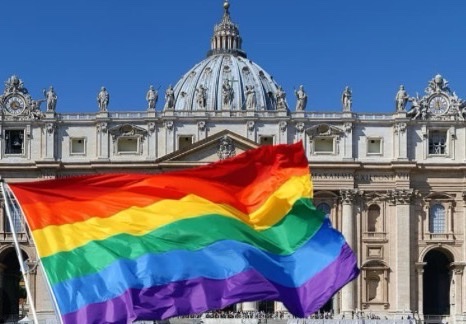
Scholars today argue that the real reason the Beguines were condemned was that they were independent women who did not properly submit to male authority. Men sought to gain control over these rebellious women. Just as many modern Christians see the LGBTQ+ Pride movement as degenerate, many Christian men in the Middle Ages felt the same about the Beguines. They regarded these women’s lifestyle as unnatural. They feared the very existence of the Beguines might corrupt and defile “God-ordained gender roles.”
In any event, the Beguines continued and flourished. The papal condemnation of the Beguines, however, was not reversed until 1321 by Pope John XXI. They were then permitted to officially resume their way of life.
Change of course comes when there are new understandings about our past. Today, women historians and women theologians are giving us new insights and added information which earlier male historians and theologians either did not know or simply wanted to hide or ignore.
We know today that in early Christianity, women presided at Eucharist and exercised various ministerial roles. An important book about this is: When Women Were Priests by Karen J. Torjesen, Professor Emerita of Religion at Claremont Graduate University. In an earlier post I have also mentioned The Hidden History of Women’s Ordination by Gary Macy, from Santa Clara University.
Today I know a number of women priests and bishops in what is known as the international Roman Catholic Women Priests movement. They are trailblazers and their day will come.
The mission of Roman Catholic Women Priests movement is to prepare, ordain, and support women who feel called by the Holy Spirit and have been called by their communities to priestly ministry.
This international movement is operating worldwide with two groups formed in the USA referred to as Roman Catholic Womenpriests-USA (RCWP-USA) and the Association of Roman Catholic Women Priests (ARCWP). Both of these organizations have international members. Today there are more than 215 women priests and at least 15 bishops worldwide. These women priests and bishops are ministering in over 34 USA states and are also present in Canada, Europe, South and Central America, South Africa, the Philippines, and Taiwan. For more information see: https://romancatholicwomenpriests.org
It is very important that we support current and potential women trailblazers in education and ministry. Their often courageous actions are necessary for achieving gender equality and fostering social progress.
Who are the women trailblazers in your community? Who are the young women who can become trailblazers? And most importantly, how can we all be supportive of them?