A Culture of Secrecy in the Contemporary Church


Transparency and Trust are Inextricably Connected


If we can move from a secretive ecclesiastical organizational style to one that encourages open access to information, participation, and decision-making, a higher level of trust and effective collaboration will exist throughout the entire community of faith…..


I guess we may never know for certain what exactly Cardinal George said about  Sister Carol Keehan, behind the closed doors of  an “executive session,” at the Spring meeting of the USCCB. And that of course is a big part of the leadership problem in our contemporary ecclesiastical leadership: the reversion to episcopal secrecy.

Over the past twenty years, we have seen an accelerated retreat to a nineteenth century Catholic ethos that sanctifies secrecy in the church.

The shift from transparency to secrecy in the USCCB is a good example. Our bishops were rather transparent in their annual meetings for the 20 years under the strongly pastoral Jadot bishops, roughly from 1973 to 1992. On Tuesday nights, during their November meetings, the bishops even hosted a “meet-and-greet” for the media just so they could listen to what journalists were saying and thinking. That all began to change as more canon lawyer,  managerial, ultramontane bishops began to replace the more theologically and pastorally minded ones. Secrecy set in, in grand style, once the secrecy-genertated-and-maintained sex abuse crisis began to explode in the new millennium.

Presently, at best, more than half of the USCCB ‘s annual meetings are held  behind closed doors.

Secerecy breeds distrust and suspicion. It keeps large segments of the church in the dark and maintains the power and control of the informed. It maintains a two-class church system. It promotes a church leadership style that can only thrive when  the “faithful” are seen as unquestioningly obedient children. Secerecy stunts healthy human development and adult faith and responsibility in the church.

Ironically, in business and politics today we see a great call for transparency and trustworthiness at the very same time that our bishops are retreating into their secretive conference rooms.

Ironically again, in the digital age greater organizational transparency is rapidly becoming a requirement for effective leadership in all segments of contemporary life…..

It is time to re-open the ecclesiastical doors. If we speak, and earnestly seek, the truth: we have nothing to hide.


Bullying Aside — Did Cardinal George or Didn’t He?


The U.S. bishops’ top communications officer has accused a Catholic media outlet of “fabricating” critical quotes from Cardinal Francis George, president of the conference, about the Catholic Health Association during a recent closed-door gathering of the bishops in St. Petersburg, Florida.
That outlet, the Catholic News Agency, is standing by its report.
Based in Denver, the Catholic News Agency is an offshoot of the Latin American Catholic news service ACI-Prensa, and partners with EWTN in an internet news service.

When Bishops Bully Women


All bullies are repugnant especially when they carry big golden sticks.


‘The bill which was passed is fundamentally flawed.

The Executive Order is meaningless.

Sr. Carol is mistaken in thinking that this is pro-life legislation,’ Cardinal George emphatically said.


Chicago’s Cardinal Francis George, head of the United States Conference of Catholic Bishops, said last week that a group of American Catholic women religious broke ranks with the USCCB on health care reform in March 2010 and were therefore responsible for the passage of the Obama healthcare program. “Sister Carol and her colleagues are to blame,” announced Cardinal George.

George’s remarks during the USCCB’s Spring meeting in St. Petersburg, Florida refer to Carol Keehan, the CEO and president of the Catholic Health Association (CHA), whose group endorsed the Obama administration’s health care bill. A statement issued by the association prior to the bill’s passage said that while the legislation was “far from perfect … (it) represents great progress in the long effort to make health care available and affordable to everyone in the United States.”

Sr. Carol Keehan waving the pen the President gave her.


During the bishops’ executive session held last week on Tuesday morning, Cardinal George recounted the events that took place prior to President Obama’s signing of the health care reform bill. George then concluded his remarks by criticizing the Catholic Health Association  and Sr. Keehan, saying they have created the dangerous precedent of a parallel magisterium to the bishops.

Frankly, it is very clear that our bishops have problems with women, especially women religious. They remind me of the big bully down the street when I was growing up. When the fellow failed in football or flunked an exam he would physically beat-up his (star-athlete) sister and verbally abuse her in the school playground. Some guys, when they cannot live with reality,  vent their own frustrations and their own shortcomings by bullying women.

These days – as part of a living US Catholic history project — I am keeping a list of bishops who bully women. So this past week, we had Cardinal George (and a lot of other pointed-hat men) in St. Petersburg.

Earlier this month we had Bishop Thomas Olmstead of Phoenix and his excommunication of Sister Margaret McBride.

A year ago in March, Bishop Robert Morlino of the Madison Diocese questioned Ruth Kolpack about the master’s thesis she wrote in 2003 about using gender-inclusive language in liturgy. Morlino demanded that she renounce her thesis. When Kolpack declined to renounce her thesis because it would be academically dishonest, Morlino fired her. For the last 25 years, Ruth had been employed at St. Thomas the Apostle Parish in Beloit, Wisconsin, serving under four pastors and three bishops. Since 1995 she’d been a pastoral associate, working in religious education, liturgy and service to minorities, living out the teachings of the church.  Ruth was fired after a 10-minute meeting with Bishop Robert Morlino.

I invite readers of ANOTHER VOICE to send me their own bishop-bullying-women stories…..

This nonsense has to stop.

The Biggest U.S. Catholic Hot Potato: Abortion


Po-Life  has to be PRO-LIFE
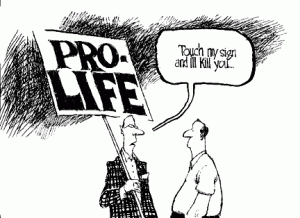
As Catholics we need to deeply reflect about the meaning of abortion and the morality of pro-life

It appears that many in the Catholic reform movement are more than squeamish about discussing the morality of abortion. They don’t want to antagonize bishops, nor do they want to be labled as “pro-abortion.”

I am 100% pro-life and I am not “pro-abortion.” …… Nevertheless, the current U.S. Catholic bishops’ intransigence about any discussion about the morality of abortion and abortion-related issues provides no helpful guidance for ethical decision-making.

Our bishops’ abortion position is particularly ironic when some of the most outspokenly anti-abortion  U.S. bishops are at the same time outspokenly pro capital punishment, strongly supported U.S. war-making in Iraq, and have even justified the use water-boarding and other forms of torture. If we are pro-life, we are pro-life.

The widely publicized excommunication of Sister of Mercy Margaret McBride by  Bishop Thomas J. Olmsted, Bishop of Phoenix, is an excellent case study for a serious and sincere discussion about the morality of abortion.

Margaret McBride, an influential member of the ethics committee at St. Joseph’s Hospital and Medical Center in Phoenix, was excommunicated and reassigned in early May because of  her role in allowing an abortion to take place at the hospital. The surgery was considered necessary to save the life of a critically ill patient.

The decision for the abortion, involving McBride, physicians and the patient, drew a sharp rebuke from Bishop Olmsted. He said abortion is not permissible under any circumstances.

Charles E. Curran, Catholic priest and moral theologian, commenting about this case and simlilar cases, wrote recently in the Tablet:

“These cases show how recent teh teaching on direct abortion found in U.S. ethical directives is; and they also indicate that such a position cannot claim a high degree of certitude….

The whole Church, the hierarchcal Magisterium and theologians must listen to the Holy Spirit speaking in the lives of Christian people — the sensus fidelium….

In my judgment, the strong reaction by many Catholics to the action taken by the Bishop of Phoenix could well indicate the sensus fidelium….

It is clear that many theologians and some bishops have come to the conclusion that an abortion to save the life of the mother is a moreally good act.

+++

Listening to the Holy Spirit and the sensus fidelium

 My friend and Roman Catholic womanpriest, Eileen DiFranco, sent me the following poignant narrative. It speaks powerfully about the need to listen to the Holy Spirit speaking through the sensus fidelium.

Mommies in Arizona


“Chancery Office, Mrs. Kearney speaking.”

“Chancery Office, this is Jose. Me and my wife Maria have five children. Maria, she’s pregnant again because we’re good Catholics so we don’t practice birth control.”

“Jose, how can I help you.”

“Maria, my wife, she’s dying.’

“How can the Chancery Office help you, Jose? Take her to the hospital so the doctors and nurses can help her.”

“My wife is in St. Joseph’s Hospital. The doctors and nurses are trying to help her. But she’s dying.”

“Jose, I think you have the wrong number.”

“No, wait, Mrs. Kearney. I need to talk to Bishop Olmstead.  Maria, she’s not breathing well. We have five little ones at home. The oldest is only eight. I already work two jobs. Maria takes care of the children.”

“Jose, the bishop is a very busy man. I’m sure he’ll pray for your wife.”

“Mrs. Kearney, tell the bishop to call me. The doctors said that the baby is making my wife sick. The baby is killing my wife. If they take the baby, Maria will live. My other babies will have a mother. I’ll have my wife.” Jose is crying now. “I can’t manage without Maria, Mrs. Kearney. There’s no one else, just me and her.”

“Jose, what you are suggesting is a sin. You must put Maria in the hands of God. God will decide whether Maria will live or die.”

Jose is sobbing and hangs up. He goes back to his wife’s room in the Maternal Intensive Care Unit. Maria has an oxygen cannula in her nose. Her brow is damp with sweat.  “What are the doctors going to do for me, Jose,” she whispers, out of breath, thrashing her head from side to side. Jose thinks that the area around her mouth is beginning to look blue. He calls the doctor who looks at the pulse oximeter on her left ring finger. “Jose, Maria’s oxygen level is dropping. We may have to put her on a ventilator to help her breathe.” “I called the Chancery Office and asked to speak to the bishop,” Jose said, holding Maria’s sweaty palm.  “I wanted to tell him what you said. That if the baby was 23 weeks, you would deliver him and put him in the intensive care nursery. He might weigh a pound. Chances are really slim, but he might live. But now, he’s only the size of a kidney bean and to deliver him means instant death. But my Maria. She’s only thirty. And I have five babies. If Maria dies, the baby dies, right? So why not save one of them?” His head hurt.  He thought Maria’s finger nails looked blue too. “That lady at the Chancery Office told me Maria is in the hands of God.” He looked at his beloved wife, whose eyes suddenly rolled back into her head. “Doctor, quick, look!” he screamed. The doctor yelled, “Code Blue” and a nurse came running in with a crash cart. Another doctor pulled out a tube and inserted it into Maria’s throat. Her oxygen level was reading 70%. Jose stood horrified as a doctor suddenly climbed on to Maria’s bed and began pushing on her chest.  Jose thought he heard Maria’s bones cracking. They worked and worked and worked on her. Sweat poured from their brows.  They gave Maria drug after drug to get her heart to start beating again. But her face just got bluer and bluer until it looked purple. And still they tried to save a 30 year old woman with five children and a loving husband. Suddenly, a nurse burst through the door. “Bishop Olmstead just called. He said that a baby is not a disease and Mrs. Colon is in the hands of God.” The doctor pressing on Maria’s chest stopped. She looked at the clock and said, “Time of death, 3:04PM, God’s time.” They had  all forgotten about Jose. He began to scream and scream and scream.  One doctor said that she would hear his screams until the day she died.  As for Bishop Olmstead, he went to bed with a clean conscience.  God had made His choice.


The Year for Priests: Special Uncensored Photo Celebration


The Year for Priests, called by Pope Benedict XVI, draws to an official conclusion on 19 June 2010.


On the  19 June closing day, St. Peter’s Square will be especially animated by priests, bishops, and the Pontifex Maximus himself: Benedictus XVI. Cameras will be clicking constantly. Images will be sent around the world with cyber speed and accuracy.

The ceremonial dress and ritual will be colorful and memorable, as only we Catholics can do!

———————————

My Personal Contribution to the Celebration

Unfortunately, due to another commitment, I will not be able to attend the events in Rome. I also realize that some priestly images of course will not be sent out during these Roman celebrations. Therefore, as my own small contribution to the Annus Sacerdotalis, I have collected some of my own favorite priestly images – Catholic and ecumenical.

My Year of the Priests Cyber Photo Collection

And so the discussion moves along as does the church……

A memorable year in so many ways.


A Brief Meditation about Vatican Colonialism


The Only Contemporary European Colonial Power?


Colonialism is a process whereby sovereignty over one colony is claimed by the monarch of the “mother” country, who as needs arise, can impose a new government, new linguistic and cultural forms, and new social structures on the colony.

Colonialism establishes and reinforces unequal relationships between the monarch and the colony and between colonists and the indigenous peoples.

Prime reasons for the practice of colonialism:

  • To expand the power and prestige of the monarch.
  • To convert the indigenous population to the monarch’s religion, often through Christian conversion missions.
  • To instill discipline and respect for authority and to control people who are  disobediently wayward

In a few weeks, on July 4th, we citizens of the United States will, of course, once again commemorate our own Declaration of Independence from colonial servitude to the King of England.

Colonialism is demeaning and destructive. It stunts normal individual and social human growth. It restricts the development and exercise of mature responsibility and shared decision-making.

When I think about Pope Benedict sending his episcopal emissaries to Ireland for the autumn 2010 Apostolic Visitation, I get a strong sense that the Holy See may very well be the last European colonial power.

The collegiality of Vatican II and the post Vatican II stress on the importance of national conferences of bishops were healthy moves away from ecclesiastical colonialism.

More than forty years ago we Catholics said it was time to move beyond all forms of colonialism.

Colonialism has no place in the Church of Jesus Christ.

————————————————————–

American Catholics Should be Especially Adverse to Colonialism.

We can be  proud of Archbishop John Carroll: our first American Catholic Bishop.


(1)      Carroll, first bishop of Baltimore, had respect for the Pope, but was keenly alert to the dangers of papal colonialism. He wanted no part of it for the developing Catholic Church in the United States.

(2)      Were Archbishop Carroll alive today, no doubt most of his successors in the USCCB would brand him a  disloyal and disobedient dissident — if not a first class heretic.

(3)      Carroll struggled to avoid “any dependence on foreign jurisdiction.” In 1783 when he heard that the Vatican independent of the American clergy, was about to appoint a superior for the American clergy he was enraged. He wrote to his English friend Charles Plowden:

“This you may be assured of: that no authority derived from the Propaganda will ever be admitted here. The Catholic clergy and laity here know that the only connection they ought to have with Rome is to acknowledge the Pope as the spiritual head of the Church. No congregations existing in his (Papal) States shall be allowed to exercise any share of his spiritual authority here.…If we are to have a bishop, he shall be an ordinary national bishop in whose appointment Rome shall have no share.”

Pope Benedict Appoints Apostolic Inspectors for the Church in Ireland


The visit is part of an investigation aimed at restoring and renewing the quality of Catholic life in Ireland.

An Apostolic Visitation, which was first signaled by Pope Benedict in a pastoral letter to the Catholics of Ireland in March,

will now take place during the Autumn of 2010.


The panel of nine “Apostolic Visitors” includes four archbishops of Irish descent, namely Cardinal Cormac Murphy-O’Connor, retired Archbishop of Westminster;  Cardinal Seán Patrick O’Malley, Archbishop of Boston;  Archbishop Timothy Michael Dolan, Archbishop of New York; Archbishop Thomas Christopher Collins,  Archbishop of Toronto; and Archbishop Terrence Thoimas Prendergast SJ, Archbishop of Ottawa.

The Visitation will begin in the four Metropolitan Archdioceses of Ireland (Armagh, Dublin, Cashel and Emly, and Tuam) and will then be extended to some other dioceses.

In its desire to promote the process of renewal of houses of formation for the future priests of the Church in Ireland, the Vatican’s Congregation for Catholic Education will coordinate the visitation of all Irish seminaries, including the Pontifical Irish College in Rome.

The Vatican-appointed examiner for the Irish seminaries is New York’s Archbishop Timothy Dolan, former rector of the Pontifical North American College in Rome. Dolan has often bragged that when rector at NAC he rescued the place from the last vestiges of 1970s liberal theology.

Last week, in a lecture at St. Patrick’s College in Maynooth, Ireland, Archbishop Dolan gave a hint of his approach during the autumn visitation/examinations. On the matter of Church teaching he strongly proclaimed in his own very special rhetorical style: “To those who claim the problem is that, as a matter of fact, Church teaching is too holy, too aloof, too distant, too out of touch, I say the problem is hardly Church teaching but lack of fidelity to it.” 

Pope Benedict is particularly fond of Archbishop Dolan’s “Let’s get back to the basics” approach,  because he is convinced that Dolan (future cardinal archbishop of New York)  embodies exactly the type of dynamic orthodoxy that will help revive the Church in the United States.

Others would argue that Dolan, like Benedict, is caught in a 1950s time warp and their episcopal limousines only go in reverse.

What do the Apostolic Visitors hope to accomplish?

We can now piece together some highlights from various announcements and news reports:

(1)   Pope Benedict XVI wants his men to clamp down on liberal secular opinion in Ireland and launch an intensive drive to re-impose traditional respect for the Irish clergy. (Frankly I never thought one could impose respect for another. People – and clergy are people – either earn respect by their words and deeds or they don’t. )

(2)   The nine-member team led by two cardinals will be instructed by the Vatican to restore a traditional sense of reverence among ordinary Catholics for their priests. (See my note above.)

(3)   Irish priests will be told not to question in public the official teaching of the church about birth control and recognizing divorced Catholics, living with new partners, and welcoming them to Eucharist.

(4)   Irish theologians will be ordered to teach “traditional doctrine.” No doubt Apostolic Visitor Dolan will help to vigorously implement this policy.

(5)   Irish lay people will be strongly encouraged to attend Sunday Eucharist faithfully and  go to private confession regularly.

(6)   A major thrust of the Vatican investigation will be to counteract “materialistic and secularist attitudes,” which Pope Benedict believes have led many Irish Catholics to ignore church discipline and become lax in following devotional practices such as going on pilgrimages and doing penance.

 So there we have it. And it all makes good Vatican sense.

When all is said and (somewhat) done, pedophilia in Ireland is really the fault of Irish Catholics who have become too materialistic, too secular, too lax, and too disobedient to Holy Mother the Church.

When the going gets tough, the Church gets tough…

The Agenda for American Catholics


Catholic and American

The Work We Need to Do

A few months ago I had lunch with a  couple bishop friends. We chatted and laughed about all sorts of things — well we are old friends — but then  the discussion turned serious. I told my friends that they and their colleagues in the US episcopacy have just about no credibility. That went over hard. We then had a brief discussion about the “important issues” confronting the Catholic Church in the United States. My bishop friends stressed what they saw as the big three. Anyone care to guess?

Yup………. abortion/euthanasia, birth control and same-sex marriage.

I then presented my list. And they looked at me bug-eyed. One friend chuckled and said, “My goodness! You and I sure live in DIFFERENT worlds!” I replied: “It’s the same world. I guess we just wear different glasses….”

In any event, I think this is the work we have to do, if we will have any Catholic credibility in our American society:

As Catholics — lay and ordained, men and women, gay and straight, young and old — we need to explore together how we can resolve major problems connected with:

  • Loss of credibility and loss of confidence in our bishops
  • Rescuing the American Catholic Church fromVatican domination
  • The role and ministry of women in the church
  • Institutional fundamentalism and cultism rooted in control, fear, and anti-intellectualism
  • Homosexuality
  • Divorce and re-marriage and active sacramental life in the church
  • Clerical celibacy
  • Declining numbers of priests
  • Major financial problems which impact all church life
  • Ministerial burnout
  • Catechetics and religious education with increased Catholic illiteracy
  • Spin-off from Pedophilia among priests and religious
  • Uncritical American Catholic citizenship