PENTECOST


A few years ago, on the evening before Pentecost, my wife and I attended a concert of sacred music in a small local church. The church was packed, with about two hundred people. The concert was marvelous and deeply moving.

When the concert finished, no one applauded. No one moved. People sat there in deep reflection for a good ten or more minutes. I whispered to my wife: “This is amazing – a deeply meditative group experience.” A few minutes later, the somewhat agitated pastor stood up, looked at his watch, and then spoke to the congregation: “Ok everybody. The concert is over. It is getting late. Time for you to go home. I need to get some sleep. Big Pentecost Mass tomorrow!”

Slowly we all got up in silence and peacefully walked out.

The next morning, I attended the Pentecost High Mass at which the pastor presided. He was a good man but lived in his own small clerical world. For Pentecost there were about twenty people present for Mass. Many showed little enthusiasm, especially when the pastor – never looking at the congregation — read his long homily from a printed leaflet. After Mass, the pastor was at the church door wishing everyone a “Blessed Pentecost.” As I walked out, I went up to him wished him a Happy Pentecost and remarked with a chuckle that he had had a full house for the Saturday evening concert. He smiled but then rather seriously said: “All the heathens came here last night.” I smiled back and said in a friendly way: “I don’t think so. They had a prayerful spiritual experience.” Hearing that he shrugged, grumbled something, and turned to greet the next person….

I think many people today are hungry for a taste of the Divine, a genuine spiritual experience, even when they may not know how to express that hunger. Their hunger is real.

This year on Easter, I was thinking about the post-resurrection experience of Cleopas and the disciple, who was probably his wife Mary, on their way from Jerusalem to Emmaus in Luke 24. They had an encounter with Jesus that touched them deeply but they did not at first recognize him.

Luke writes that they met a fellow traveller who talked with them about the events in Jerusalem but then acted as if he were going farther. “But they urged him strongly, ‘Stay with us, for it is nearly evening; the day is almost over.’ So, he went in to stay with them. When he was at the table with them, he took bread, gave thanks, broke it, and began to give it to them. Then their eyes were opened and they recognized him, and he disappeared from their sight. They asked each other, ‘Were not our hearts burning within us while he talked with us on the road and opened the Scriptures to us?’”

A healthy church gives people living bread, feeding not only their minds but warming their hearts as well: providing profound experiences in which they feel connected intimately to Someone larger than themselves. We call that the Sacred, the Divine, the Ground of Being or God. I suspect many people today feel like uncertain travellers looking for a map and a faithful spiritual guide.

Christian leaders with meaningful words, symbols, and rituals can indeed give direction and secure guidance. They can enable people to enter into a deeper dimension of life, an experience of the Divine, inspired by the great Christian leader, who said: “I have come that they may have life, and that they may have it more abundantly.” John 10:10

Happy Pentecost!

  • Jack

PS In keeping with my summer vacation tradition, I will be away from Another Voice until late June. A bit of time for reflection, research, and R&R.


2026 Ascension Thursday Reflection: God, Heaven, and the Universe


Staring into the sky on a clear spring night, my thoughts turned first to the complex immensity of the universe. What a delight to look at the moon and stars after far too many cloudy days and nights.

Almost all of the stars we can see are close to Earth in galactic terms. Most within a hundred light-years or so. A “light-year” is the term used to express astronomical distances, because light is the fastest-moving visible radiation in our universe, and travels at 186,000 miles per second. So, a light-year – the distance that light travels in 365 days – is 5.88 trillion miles. Some stars are visible from 1,000 light-years away. But even then, that is only 1% of the distance across our galaxy which we call “The Milky Way,” a slowly rotating cluster of more than 200 billion stars!

Our Milky Way galaxy is one of many galaxies, and galaxies like the Milky Way have about 17 billion Earth size planets. Just a few years ago, researchers estimated that there were between 100 and 200 billion galaxies in our observable universe. Today, however, astronomers suggests that the total size of the universe is unknown and could very well be infinite, implying there could be an infinite number of galaxies, because the universe is still expanding.


Looking up at the stars, I thought about Psalm 19: “The heavens declare the glory of God.” I thought as well, with fascination and amazement, that with such an immense and expanding universe we probably need to expand our perspectives on God the Creator.

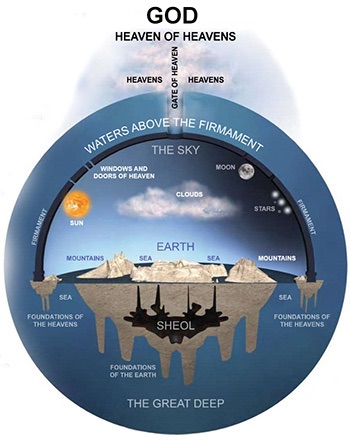
Despite our contemporary scientific and technological progress, much of our official God imagery, and our images of Ascension Thursday, are rather dated and still influenced by the ancient Hebrew cosmology dating from around 1200 BCE.

The ancient Hebrew cosmology viewed the universe as a three-tiered structure: a flat disk-shaped Earth set on a foundation of pillars. Above the Earth was the “firmament” a dome on which the stars, planets, sun, and moon revolve. Heaven, the realm of God, was understood as a set of chambers just above the firmament. A special passage, like a tunnel through the clouds, led from Earth up to Heaven. The firmament dome surrounded the Earth, with its edge meeting at the horizon. See, for example, Genesis 1:7: “Thus God made the firmament and divided the waters which were under the firmament from the waters which were above the firmament; and it was so.” The firmament was supported by “pillars” or “foundations,” thought to be the tops of mountains, whose peaks appeared to touch the sky. The heavens had doors and windows through which God could send rain and let waters above flow down on Earth. And also control waters from below. See, for example, Genesis 7:11: “In the six hundredth year of Noah’s life, on the seventeenth day of the second month, on that day all the springs of the great deep burst forth, and the floodgates of the heavens were opened.”

The Underworld, the realm of the dead was located under the Earth. The most frequent term for this place was Sheol. The graves dug by humans represented gateways to the Underworld. Below the Earth and the Underworld were the lower seas or “the Great Deep.”

The ancient Hebrew understanding of the universe had a long-lasting impact on the Christian understanding of the universe. The final version of the Apostles Creed, written between 700 and 750 CE, says that, after his death, Jesus “descended into the Underworld.” Most people, however, know only the very faulty English translation of the Apostles Creed which says that Jesus “descended into hell.” Very unfortunate. Good and correct translations are so important.

The Ascension of Jesus, according to Luke 24:51 and Acts 1:1-9, was a journey in a cloud up to Heaven. In their Hebraic universe understanding, early Christians no doubt pictured the Resurrected Jesus passing through the tunnel in the clouds up to heaven to sit on a throne at the right hand of God the Father.

Much later, in the seventeenth century, some elements of the ancient Hebrew universe perspective, maintained by the Catholic Church, led to the trial and condemnation of Galileo Galilei by the Roman Catholic Inquisition in 1633. The reason: Galileo supported heliocentrism in which the spherical Earth and planets revolve around the Sun.

Some old cosmological images do last a long time. I was a pious grade school kid, when on November 1, 1950, Pope Pius XII (1876-1958) solemnly proclaimed in his apostolic constitution Munificentissimus Deus, that in was: “…a dogma revealed by God that the immaculate Mother of God, Mary ever virgin, when the course of her earthly life was finished, was taken up body and soul into the glory of heaven.” Body and soul up there above the Earth.

I also remember the Soviet cosmonaut Yuri Gagarin (1934–1968) who was the first person in outer space, completing a single orbit of Earth on April 12, 1961. The famous phrase “I see no God up here” was widely attributed to him. But today historians stress  that the phrase did not originate with Gagarin but came from a speech by Nikita Khrushchev (1894-1971), First Secretary of the Communist Party of the Soviet Union from 1953 to 1964. Khrushchev used it to promote Soviet state atheism. Yuri Gagarin, in fact, was a baptized, believing Russian Orthodox Christian, despite the Soviet Union’s official state atheism. 

Well, today we need to move beyond ancient cosmology and antiquated theology based on it. So much of our religious perspective has been anchored in outdated ideas about the universe and planet Earth’s place in the universe.

In an ever-expanding universe, we need an expanded image of Creator God and a broader theology about God. That theology should be like poetry, which takes us to the end of what words and thoughts can do and redirects our minds and hearts. All religious language must reach beyond itself into a sort of silent awe and amazement. It is like describing being in love. We realize of course that God is always greater than anything we can understand.

As I wrote last week, sometimes people get so wrapped up in their religious words and rituals that they miss what those words and rituals are really about.

We all have moments of awe, wonder, and excitement that lift us beyond ourselves, when we realize that something very close and real is touching us very deeply within.

We need to spend more time reflecting on those kinds of experiences, through spiritual reflection and meditation. And this must be a major part of a re-focusing of Christianity in our time.

Spiritual reflection cuts across all religious traditions and addresses the non-religious as well. I often think about the observation of Dag Hammarskjöld (1905-1961) the Swedish economist and diplomat who served as the second Secretary-General of the United Nations from April 1953 until his death in a plane crash in September 1961.”God does not die on the day when we cease to believe in a personal deity, but we die on the day when our lives cease to be illumined by the steady radiance, renewed daily, of a wonder, the source of which is beyond all reason.


  • Jack


Perspectives on God


As a follow-up to last week’s reflection about Christian Nationalism, a brief reflection this week about God.

Perspectives on God are important. In Genesis, first book of the Hebrew Bible, we read that God created humanity “in God’s own image.” (Genesis 1:27) But periodically over the years, some people have tried to make God in their own image and likeness. Vindictive images of God have been used by Christian Nationalists to control, manipulate and even destroy people.

I don’t understand God as a vindictive and hard-nosed authoritarian. In the New Testament, such an understanding of God does not resonate with the historical Jesus’ understanding of God, as his loving Father.

Unfortunately, some medieval Christian theologians did have distorted authoritarian notions about God, and they passed them on to future generations. Anselm the famous Archbishop of Canterbury from 1033 until his death in 1109 is a good example. Anselm saw God as a nard-nosed judge and taskmaster. Anselm believed that human sin and human disobedience to God, going back to the first humans, had defrauded God of the honor that God was due. That offense to God’s honor, Anselm taught, had to be compensated for and repaired.

Anselm said that God could only be satisfied by having a being of infinite greatness, God’s very own Son acting as a human, repay the debt owed to God and thereby satisfy the injury to God’s honor. In other words, God would only be happy when God’s own Son was tortured and suffered a cruel death. What a strange image of God. Catholic theology has called it the “Satisfaction Theory of Atonement.”

Jesus and early Christians, however, clearly understood God as loving and kind. That is essential. That is where we begin. As my Nijmegen Catholic theological mentor and long-time friend Edward Schillebeeckx OP (1914 – 2009) often said: “Christianity began with an experience, an encounter with Jesus of Nazareth which caused people to discover new meaning and to direct their lives in a new direction.”

The clear message of Jesus was and still is that the Divine Presence is here, with us, and with all of creation. God is not simply “out there” in some far-off realm. The Jesuit philosopher and theologian Karl Rahner (1904 – 1984) stressed, however, that people do not come to know God by solving doctrinal conundrums, proving God’s existence or engaging in an abstruse metaphysical quest. Rahner stressed the importance of Divine mystery as very simply an aspect of our humanity.

Our challenge is to live that Mystery with openness and calm reflection. That Mystery, which defies exact description, is God. Religious doctrines have their place but can never totally explain or define that Mystery.They are symbolic or analogous pointers toward God. When people focus only on the pointers, however, they really miss the point.

As contemporary believers we have to ask how we can develop better pointers that really help point people towards God. We need pointers anchored in all the complex realities and needs of our time, enabling people to believe and deal with human suffering with serenity and courage. Many of us learned about God at about the same time we also learned about the Easter Bunny. As we grew in awareness, our understanding of the Easter Bunny phenomenon evolved and matured. But for many people their religious belief has remained somewhat static and adolescent. 

Divine revelation is not an event that happened once in the past. It is an ongoing and creative process that requires human perception and contemplation. Revelation is a part of reality. We are called to be open, alert, and contemplative. Faith means trust, commitment, and engagement. But too often it is mistakenly understood as simply an intellectual assent to ecclesiastical propositions.

Today, as science itself says there is so much we still don’t know. It is time perhaps to return to a theology that asserts less and is more open to mystery and calm and reflective exploration. This may not be easy for contemporary people so used to getting instant information with a click on a cellphone or checking their favorite website or social network.

The image of a domineering and controlling God is an archaic image. We journey today with a different and more of a traveling-companion God, even if we struggle with descriptive words about God. “No one has ever seen God; if we love one another, God abides in us and his love is perfected in us.” (1 John 4:12) The true and essential work of all religions, but especially Christianity, is to help us recognize the divine image in everyone and everything.

My concluding reflection this week comes from the priest and theologian Ronald Rohlheiser OMI, a friend who also completed his doctorate at the Catholic University of Leuven: “God lies inside us, deep inside, but in a way that’s almost non-existent, almost unfelt, largely unnoticed, and easily ignored. However, while that presence is never overpowering, it has within it a gentle, unremitting imperative, a compulsion towards something higher, which invites us to draw upon it. And, if we do draw upon it, it gushes up in us in an infinite stream that instructs us, nurtures us, and fills us with endless energy.”

Our perspectives on God are important and worth sharing. For me, God is my traveling companion on the great journey.

  • Jack