Staring into the sky on a clear spring night, my thoughts turned first to the complex immensity of the universe. What a delight to look at the moon and stars after far too many cloudy days and nights.
Almost all of the stars we can see are close to Earth in galactic terms. Most within a hundred light-years or so. A “light-year” is the term used to express astronomical distances, because light is the fastest-moving visible radiation in our universe, and travels at 186,000 miles per second. So, a light-year – the distance that light travels in 365 days – is 5.88 trillion miles. Some stars are visible from 1,000 light-years away. But even then, that is only 1% of the distance across our galaxy which we call “The Milky Way,” a slowly rotating cluster of more than 200 billion stars!
Our Milky Way galaxy is one of many galaxies, and galaxies like the Milky Way have about 17 billion Earth size planets. Just a few years ago, researchers estimated that there were between 100 and 200 billion galaxies in our observable universe. Today, however, astronomers suggests that the total size of the universe is unknown and could very well be infinite, implying there could be an infinite number of galaxies, because the universe is still expanding.
Looking up at the stars, I thought about Psalm 19: “The heavens declare the glory of God.” I thought as well, with fascination and amazement, that with such an immense and expanding universe we probably need to expand our perspectives on God the Creator.
Despite our contemporary scientific and technological progress, much of our official God imagery, and our images of Ascension Thursday, are rather dated and still influenced by the ancient Hebrew cosmology dating from around 1200 BCE.
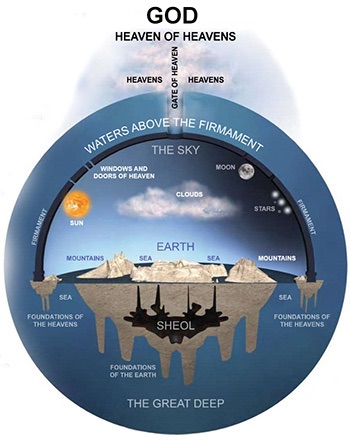
The ancient Hebrew cosmology viewed the universe as a three-tiered structure: a flat disk-shaped Earth set on a foundation of pillars. Above the Earth was the “firmament” a dome on which the stars, planets, sun, and moon revolve. Heaven, the realm of God, was understood as a set of chambers just above the firmament. A special passage, like a tunnel through the clouds, led from Earth up to Heaven. The firmament dome surrounded the Earth, with its edge meeting at the horizon. See, for example, Genesis 1:7: “Thus God made the firmament and divided the waters which were under the firmament from the waters which were above the firmament; and it was so.” The firmament was supported by “pillars” or “foundations,” thought to be the tops of mountains, whose peaks appeared to touch the sky. The heavens had doors and windows through which God could send rain and let waters above flow down on Earth. And also control waters from below. See, for example, Genesis 7:11: “In the six hundredth year of Noah’s life, on the seventeenth day of the second month, on that day all the springs of the great deep burst forth, and the floodgates of the heavens were opened.”
The Underworld, the realm of the dead was located under the Earth. The most frequent term for this place was Sheol. The graves dug by humans represented gateways to the Underworld. Below the Earth and the Underworld were the lower seas or “the Great Deep.”
The ancient Hebrew understanding of the universe had a long-lasting impact on the Christian understanding of the universe. The final version of the Apostles Creed, written between 700 and 750 CE, says that, after his death, Jesus “descended into the Underworld.” Most people, however, know only the very faulty English translation of the Apostles Creed which says that Jesus “descended into hell.” Very unfortunate. Good and correct translations are so important.
The Ascension of Jesus, according to Luke 24:51 and Acts 1:1-9, was a journey in a cloud up to Heaven. In their Hebraic universe understanding, early Christians no doubt pictured the Resurrected Jesus passing through the tunnel in the clouds up to heaven to sit on a throne at the right hand of God the Father.
Much later, in the seventeenth century, some elements of the ancient Hebrew universe perspective, maintained by the Catholic Church, led to the trial and condemnation of Galileo Galilei by the Roman Catholic Inquisition in 1633. The reason: Galileo supported heliocentrism in which the spherical Earth and planets revolve around the Sun.
Some old cosmological images do last a long time. I was a pious grade school kid, when on November 1, 1950, Pope Pius XII (1876-1958) solemnly proclaimed in his apostolic constitution Munificentissimus Deus, that in was: “…a dogma revealed by God that the immaculate Mother of God, Mary ever virgin, when the course of her earthly life was finished, was taken up body and soul into the glory of heaven.” Body and soul up there above the Earth.
I also remember the Soviet cosmonaut Yuri Gagarin (1934–1968) who was the first person in outer space, completing a single orbit of Earth on April 12, 1961. The famous phrase “I see no God up here” was widely attributed to him. But today historians stress that the phrase did not originate with Gagarin but came from a speech by Nikita Khrushchev (1894-1971), First Secretary of the Communist Party of the Soviet Union from 1953 to 1964. Khrushchev used it to promote Soviet state atheism. Yuri Gagarin, in fact, was a baptized, believing Russian Orthodox Christian, despite the Soviet Union’s official state atheism.
Well, today we need to move beyond ancient cosmology and antiquated theology based on it. So much of our religious perspective has been anchored in outdated ideas about the universe and planet Earth’s place in the universe.
In an ever-expanding universe, we need an expanded image of Creator God and a broader theology about God. That theology should be like poetry, which takes us to the end of what words and thoughts can do and redirects our minds and hearts. All religious language must reach beyond itself into a sort of silent awe and amazement. It is like describing being in love. We realize of course that God is always greater than anything we can understand.
As I wrote last week, sometimes people get so wrapped up in their religious words and rituals that they miss what those words and rituals are really about.
We all have moments of awe, wonder, and excitement that lift us beyond ourselves, when we realize that something very close and real is touching us very deeply within.
We need to spend more time reflecting on those kinds of experiences, through spiritual reflection and meditation. And this must be a major part of a re-focusing of Christianity in our time.
Spiritual reflection cuts across all religious traditions and addresses the non-religious as well. I often think about the observation of Dag Hammarskjöld (1905-1961) the Swedish economist and diplomat who served as the second Secretary-General of the United Nations from April 1953 until his death in a plane crash in September 1961.”God does not die on the day when we cease to believe in a personal deity, but we die on the day when our lives cease to be illumined by the steady radiance, renewed daily, of a wonder, the source of which is beyond all reason.
- Jack


Dr. Jack,
Thank you for pleading the case for “good and correct translations”! We sorely need to invite light into the shroud of facile assumptions that veil truths [dark and light] behind the words compiled in the Lectionary. Its compilation is a pile: ancient scripture somewhat referential to a liturgical calendar that marches on, year after year, though the times have changed along with the use of language.
English is a rich language but with much baggage to unpack from other cultures. That is why scripture is slow-going, with my Latin, Greek, Aramaic and Hebrew concordances and etymologies close at hand, to pierce the shroud to reveal the light-filled verities that are “very close and real” to us everyday, forefending the darkness that seeps into our minds and times.
Struggle with the translations.
Test-drive them to analyze what the author’s words meant then.
Listen for how we interpret that meaning for us now.
This process of engagement does not polarize, but rather complements the co-existence of life and death, and the love of the Creator in our loving one another= those two great commandments inherited from the Hebrew tradition.
I believe the price of truth behind language and translations is a precious pearl. I also agree with Dr. Schweitzer, that the verition of what being human means– and healing all Life, i.e., “practical eschatology” — outstrips every philosophy and theology.
The latent truths about ourselves, those that survive in our unconscious from eons of pre-magic times, find expression still in symbolic liturgical customs. Mystery abounds and astounds:
It is a mystery to me that the dramatic liturgical trappings of violent blood-sacrifice in rubric and ritual still obscure the truth for which Jesus of Nazareth taught then, and calls to us now, about how to live with each other, in the light. For that, the state crucified him as a traitor.
It astounds me that He dwells among us still, as He said, if we have eyes to see, ears to hear, and hands to heal.
Maybe if we let go of some glitzy trappings and dubious translations, engage in “Gelassenheit” and more group-meditation, we might relieve the angst of analysis and calculations with Light itself, to balance better the burden of one-another’s suffering.
Yes, we need to change the lenses, not a matter of optics so much as of risk-enhancement, in hope and faith. As Dr. Luther once wrote (translated), “Lord, I believe: do Thou help my unbelief!”
Very well said Dan.
I greatly appreciate your reflection.
Jack